Showing posts with label Urban Birding. Show all posts

Monday, May 13, 2019

Whiskered Pitta and Bicol Ground Warbler

October 2018: Another Quick Trip to the Philippines and More Endemics on Luzon

Friday, October 19 - Jariel's Peak

I'd managed to escape from a business trip in Hong Kong on Thursday night, hopped a quick flight, and once again found myself staying near Manila airport, exhausted but ready for more Philippines birding adventures.  This was going to be another super quick trip as I had to be back in Hong Kong on Sunday afternoon to catch a flight to New York, but hopefully I was going to get a chance to see a few more of Luzon's endemic birds before then.  This time I was with famous Robert Hutchinson, one of the owners of Birdtour Asia and a long time Philippines resident.  We set off very early on Friday morning missing most of Manila's legendary traffic and arriving at our destination well before first light.  Jariel's Peak is a apparently local beauty spot and we planned to spend a day and a half birding there but as we'd arrived in the pitch darkness the views were going to have to wait.  Besides, I was more interested in owls.

We had a specific target in mind so started stopping and listening for owls, hoping for a Luzon Scops-Owl.  We heard Philippine Scops-Owl and several Philippine Nightjars but for a time our target eluded us until Rob heard one calling and was able to use his fancy night-scope to see where the bird was.  Even though we knew which tree it was in, and it's location stood out in the green glow if the night scope, the bird was hidden from me and it took a while before I caught some movement, fired off a volley of shots into the darkness and got a photo .... it may be out of focus, but it was a life bird nevertheless!

Luzon Scops-Owl
With the owl in the bag, we could relax and as the sun came up we settled in for a very pleasant morning of birding.  The targets here were many and there were some very special birds that I very much wanted to see.  While the day was young we focussed on tracking down two colorful fruit-doves, the gaudy Flame-breasted Fruit-Dove and the subtly beautiful Cream-breasted Fruit-Dove, both Philippine endemics and both of course life birds for me.  We also started to rack up a decent species count and more of more of the local birds slowly revealed themselves and I hit a milestone of sorts when a Blue-headed Fantail became my 4,500th species.

Cream-breasted Fruit-Dove
With the more common birds joining the list, we broke away from the roadside birding to work on some of the harder to see endemics.  The WHISKERED PITTA is a jewel of a bird and like all pittas can be very difficult to see as they hop around on the forest floor, seemingly always finding a way to stay out of sight.  We heard a bird calling and scrambled into the forest along the course of a small stream working our way up through the rocky ravine to a place closer to the bird and away from the road.  Once there we found a place to sit quietly and watch while Rob played the tape hoping to make the pitta a little curious and entice it to come in closer.  After thirty minutes of waiting silently in the forest, the pitta simply popped up on a rock very close to us and stayed in view, seemingly indifferent to our presence, for the next ten minutes while it searched among the boulders along the stream for the intruder it had heard.  A very special audience with a very special bird.

It's hard to imagine that birds this colorful can be hard to see but they are
very good at hiding.  Whiskered Pitta.

The other 'hard to see' target bird was the local, endemic, BICOL GROUND-WARBLER and this bird did require some serious effort to see.  This species is a mouse of a bird, tiny, dark brown, and very fond of getting down amongst tangled weedy vegetation so dense that you might be feet from one and still never see it.  We heard a number of the ground-warblers calling in the morning but seeing one required a little more staging.  In order to get a glimpse of the bird, some gardening was involved, with Rob cutting a small break in the roadside weeds so that, if we were able to entice the bird close, we might get at least a glimpse of it as it crossed our artificial micro-clearing.  Even with the preparation it still required the bird to cooperate and we had several non-cooperative birds before one made a fatal mistake and allowed itself to be briefly seen.  There are no good photographs of this bird and I was hoping to get a few but, even though I managed to get the bird in the view finder briefly, there were always some pieces of vegetation in the way that ruined the focus.  Still, a very good bird to add to the life list.

Green-backed Tailorbird, a lifer but not a Ground-Warbler.
As the day wore on and we moved further up the road, the bird activity quietened down a little which gave us a chance to have some lunch and to watch for raptors.    We then birded our way back down the road, adding more species, getting better views of others and generally enjoying a great day of birding.

Rufous-bellied Eagle and Philippine Serpent-Eagle 

Finally, as the light started to fade, we had one more target which was a bird I had dreamed about and not expected to see.  After a long dusk vigil that stretched well past darkness though I had to accept that the Bukidnon Woodcock was going to have to stay in my dreams and not join my list (my luck with Asian Woodcock is not great and I added this miss to my missing Javan Woodcock the year before).

Saturday, October 20 - Jariel's Peak

Up well before dawn again and more time with the nightjars and scops-owls before it got light.  We had the morning to bird the same road again for birds that we hadn't seen the day before.  There weren't that many birds we hadn't seen though so we were able to relax and just enjoy the birds that came to us.

Rufous Hornbill
The highlight for me was Philippine Trogon, a bird I had hoped we'd see and were able to track one down and see it well in the understory.  We also tracked down the Philippine form of White-browed Shortwing, a species due to be split in the near future and one where I have been lucky enough now to see several of the island forms giving me several "banked" lifers when the split happens.

Philippine Trogon
All too soon it was time to leave and start making our way back to Manila.  There were two more birding stops to make though, and hopefully a few special birds to add.

Stop number one was the famous Angono Petroglyphs Museum which protected some truly ancient art but also protected some large trees and was a nesting site for the peculiar Philippine Eagle-Owl.  This is a big owl, but somehow looks odd for an eagle-owl, it also apparently eats mostly frogs, so perhaps is more closely related to the fish-owls?  Either way it's an impressive bird and for a huge owl was surprisingly hard to find even though we knew roughly which group of trees the bird was likely to be roosting in.  In the end it was a friendly local security guard who moved us to exactly the right angle to get a view of the bird, I doubt I would have found it otherwise, so very happy for friendly locals.

The huge, and well hidden Philippine Eagle-Owl.
Then finally, one last stop at La Mesa Eco Park in Quezon City, the stakeout for the endemic Ashy Thrush.  We got to the park late in the day and it was of course crowded with people leaving me wondering how a rare, endemic bird gets along in such crowded quarters.  We didn't need to worry about the people though as soon enough the heavens opened unleashing torrential tropical rain on us and leaving us trying to find shelter under trees but getting soaked through nevertheless.  The rain did chase away the crowds though and with the people gone the birding looked up we soon found an Ashy Thrush hopping around near the trails.

So a great trip, something like 35 life birds for me, and a nice addition to my weekend in Subic Bay earlier this year.  The Philippines is truly daunting with so many islands and so many endemics but at least I've started chipping away at it.  So special thanks for Rob for the expert bird guiding and good company.  I can't wait to get back to the Philippines again.


Sunday, May 5, 2019

Finding Vagrants in Hong Kong

October 2018: An Epic Day if Birding at Mai Po and other Hong Kong Wetlands

Sunday, October 14

October 2018 got a little confused - I had had an October trip planned to Asia for months and was looking forward to trying for Mountain Peacock-Pheasants in Malaysia and for Whiskered Pitta in the Philippines.  Then, just weeks before I was due to leave, the trip got cancelled and I had to try to un-book the travel arrangements.  No sooner had I said my apologies though, and cancelled all the ground arrangements for the trip, than I got word that schedules had changed again and that I was indeed free to go to Asia if I wanted!  It was too late to save the Malaysia part of the itinerary, but I was able to resurrect the Philippines trip (more later) and had a single spare day in Hong Kong so reached out to birding friend and local bird guru John Allcock to make plans for a day of birding, including a visit to the fabled Mai Po reserve.

So super early, up and out of the hotel and off to the New Territories to meet John.  First stop was a woodland trail at Shek Kong which, given the date, we hoped would be crawling with interesting migrants.  It wasn't.  In fact it was pretty dead bird-wise, but oh well, never mind, and on to the next spot.

Kam Tin is not the most scenic birding area on earth.  A muddy storm drain full of discarded tires and shopping carts surrounded by concrete banks and overpasses.  It is a wetland though and so draws lots of wetland birds with a good selection of shorebirds and egrets spread up and down the muddy channel.  Our target here was the scarce and declining Gray-headed Lapwing, a lifer for me and a bird I'd looked for unsuccessfully at this site the previous year.  We got out of the car, I scanned the channel, picking up a good selection of birds but no lapwings, but thankfully John was more thorough and picked out a pair in the distance.  So, a life bird, and the day was starting to look up.

Gray-headed Lapwings in scenic surroundings.
Up next was another site I'd birded before, the farm fields and paddies of Long Valley.  Our goal here was to look for scarcer buntings amongst Yellow-breasted Buntings in the dry rice fields and see if we could turn up a rarity or two.  We ended up not finding anything very different but I did get another life bird when we flushed a Lanceolated Warbler a couple of times; a tiny, mouse-like, skulker but very welcome on the list.  And now onwards and time for the main event.

Azure-winged Magpies at the Mai Po HQ Building
Mai Po is world famous.  The marshes, fish ponds and mud flats of the reserve have been intensely birded and studied for years (a function of there being British birders in Hong Kong) and are legendary in birding circles.  I had actually been there once before but, lacking the correct permit, had not been able to access the best parts of the reserve at the right time and had seen very little.  This time I was properly permitted and birding with a local expert so my expectations were high and I'm happy to say they weren't disappointed.

Over the next six hours we saw more than 80 species at Mai Po, including 4 life birds for me.  On the way to the mud flats we worked our way through the fish ponds and found Black-browed Reed Warbler, Pied Harrier and Collared Crow, all of which were life birds for me.  We also flushed a bird that we were pretty sure was a White-browed Crake, a mega-rarity in Hong Kong, but were unable to re-find it so had to let the record go.  Then we spent several hours enjoying some of the best shore birding there is on offer anywhere in the world.

The mud flats at Mai Po are viewed from floating hides at the end of long boardwalks that lead out through the mangroves to the shores of the Pearl River.  The mud was quite literally covered in birds, and with a rising tide we took our places in the hides and started to study them as they got closer and closer.

The mud at Mai Po is literally carpeted with shore-birds and wading birds (plus a Collared Crow).


Wading birds were initially most obvious with three species of egret, several herons and the globally endangered BLACK-FACED SPOONBILL all feeding out on the mud.  Beneath them though was a carpet of shorebirds ranging in size from the larger  Eurasian Curlews, Whimbrels, and Black-tailed Godwits down to the smaller plovers and sandpipers running between their legs.  The reserve was famous for a trinity of very rare Asian shorebirds that would all have been potential life birds to me - Nordmann's Greenshank, Asiatic Dowitcher and Great Knot - and while diligent scanning didn't pull out either of the first two, we did find a couple of GREAT KNOT, a bird I was very happy to finally add to my list.

Eurasian Curlew and Whimbrel

We also managed another bird that was interested for me when we found a Long-billed Dowitcher, a bird I think of as North American but apparently they breed in small numbers in Asia too.

The greatest excitement of the day though was when John, scanned through the hundreds of Pacific Golden-Plovers handed me the scope and said, "what do you think about this one?".  He knew the answer already of course, the eye-pattern was different and a sort of breast-band effect strongly suggested EUROPEAN GOLDEN-PLOVER, only the 3rd one ever recorded in Hong Kong!

European Golden-Plover
So a great day, and with a few hours to kill we headed over to the San Tin fish ponds to see if we could add a few extra species.  We weren't expecting to top the excitement of the plover but not 10 minutes after arriving we stumbled into another rarity, Hong Kong's 4th record of BOOTED WARBLER which we flushed from some grass and managed to get a few record shots of.  Truly a great day of birding and all in one of the most densely populated places on earth.

Booted Warbler


Sunday, August 26, 2018

Ancient Moles and Rare Sparrows

August 2018: A Foodie Trip to Mexico City with a few Sparrows Thrown In

Friday, August 10 - Sunday, August 12 - Mexico City

This was most definitely not a birding trip, just making this clear.  We went to Mexico City to eat and to celebrate my birthday.  Besides my bird list, the other passion that drives my travel (and certainly drains my bank account) is my fondness for the World's Fifty Best Restaurants.  Two of these restaurants, QUINTONIL and the legendary PUJOL are located in Mexico City and I'd made reservations at both for a blow-out foodies weekend.

Sea Urchin 'Pozole' at Quintonil
Even though I did end up getting a new bird for my Mexico list while I was in the City (Mexican Duck was split on eBird that weekend and we saw some in a city park), we spent the weekend eating, drinking, and working our way through a small sample of Mexico City's amazing museums.  The city is huge, but surprisingly navigable and generally feels safe and friendly.  The food of course was simply out of this world.

Corn (with a sauce made from Ants) and a 1,000-day-old Mole
at Pujol


Monday, August 13

With a free morning but needing to be in Guatemala City in the afternoon, I'd reached out to local birders to see if I could squeeze in a few Mexican birds before I had to leave.  Rafa Calderon, a local biologist and passionate birder had taken up the challenge so at 5:30am I left the very fancy Four Seasons Hotel (dressed a little scruffier than the doormen would have liked) and headed off for a precious few hours with the birds of the Mexico City area.

After an hour or so driving to get out of the City, we climbed up into the surrounding volcanic highlands and found our way to our first birding spot.  Park Las Maravillas was a picnic area, a bunch of tussock grass and some trail-heads that led up into some mixed Pine-Oak forest on the volcanoes above the city.  When we arrived it was also dark, cloudy and damp but, negotiating our way in through the gate, we pulled over near the tussock grass and waited for it to get light enough to bird.

Striped Sparrow
Our target here was a rare and restricted range bird that I had long wanted to see, the SIERRA MADRE SPARROW.  The sparrow lives in the tussock grass, a habitat all too easily converted to agriculture, and sings from the top of the grass stalks but is shy and drops down quickly upon approach.  As it got lighter we got out of the van and started our search, avoiding the tussocks in part because it's a fragile habitat and in part because of the high density of rattlesnakes (!).  STRIPED SPARROWS (a lifer) and Canyon Towhees were abundant and obvious around the picnic area but we had to walk a little way before we heard our target and searched the exposed grass tops for a while before seeing a bird that looked like a small reddish Song Sparrow but with a very distinctive song.  Success!  We ended up getting some good view although they always managed to drop down before I got close enough for a photo.  Still, the memory of the bird and the place is solidly imprinted on my mind ... sparrow, volcanoes, drifting clouds, giant sprawl of Mexico City laid out below us ... it was memorable.

With the two life sparrows in the bag we headed off up the trail, soon adding a third lifer when we bumped into some STRICKLAND'S WOODPECKERS (a bird I used to have on my list before the Strickland's/Arizona Woodpecker split some years back).  The rest of the birds on the trail had a very Western US kind of feel, many would be familiar to US birders from Arizona - Western Bluebird, Olive Warbler, Steller's Jay, Mexican Chickadee, Yellow-eyed Junco, etc.  but there were also some great Mexican specialties like Long-tailed Wood-Partridge and Red Warbler.  All-in-all a very pleasant way to spend the morning.

Strickland's Woodpecker
With a few hours left before I had to head to the airport, a quick scan of my bird-needs-list revealed only one realistic life bird possibility, the BLACK-BACKED ORIOLE.  My guides didn't think that would be a hard bird to see but it ended up leading us on a merry chase before we finally got one several hours later.  First we stopped at the very birdy Bosque del Tlalpan, a large urban park with decent forest patches,  before finally tracking down our target at the very well laid out Jardín Botánico.


Mexico City does seem to have some great places to bird, especially some decent little urban migrant traps, and also a growing birding community.  In the end we had 64 species and I had 4 lifers.  Not a bad outcome for a spare morning in a large urban area.  Will definitely come back for the food, but there are also a few more birds that I'd love to chase next time I'm here.  Mexico is also just a wonderful place to visit and full of the warmest, most genuine people you'll meet anywhere.  The US Media loves to give a very one-sided picture of Mexico, don't believe the hype, go see it for yourself.


Saturday, July 14, 2018

Asian Urban Birding (Part 7) - Subic Bay

A Quick Weekend in the Philippines

Friday, April 13, 2018 - Subic

I'll be honest, the Philippines intimidate me.  7,000+ islands, not all of them terribly accessible given security issues, 230+ (and growing) endemic species, and it's all a very long way from New York.  So I'd never managed to get there before this year and I certainly never had time to do the 2-3 week trips that most birding companies offer.  This year though, I did find myself in an adventurous mood and with a free weekend in Hong Kong.  So I jumped on a Philippine Air flight to Manila, met up with (super talented young) local bird guide Mark Jason Villa and headed out to spend the weekend at Subic Bay.

Subic is an odd city to say the least, a city built around the former U.S. Naval Base at Subic Bay, now converted into a port/enterprise zone for commercial development.  Much of the housing in the city is left over from the base, and many of the commercial buildings were either part of the base or grew up around it.  The former military zones of the base sprawl across a lot of land and are dotted with old structures, half grown-over concrete bunkers and the like.  It did and does contain a fair amount of forest though, and thats what attracts birders.

Concrete bunkers are everywhere in the 'forest'
We had two full days to bird the Subic area and our goals were really to see as many of the endemic species as we could.  We had plenty of time for most of the resident locals and they came quickly to the list so we spent more time focussing on a couple of special and hard to get species with some mixed results.

The fist morning was very, very birdy and I had a slew of life birds.  Among the endemic species on the first morning were Brown-breasted and Spotted Kingfishers, Philippine and Rufous Coucals, Luzon Hornbill, White-bellied, Philippine and Northern Sooty WoodpeckersLuzon Flameback, Philippine Hanging-Parrot, Green Racket-tail, and many more.  There were also some endemics with hard to remember local names ... Guaiabero, Balicassiao, and Coleto ... which gave the list a decidedly exotic feel.  In all, 25 of the 40 species we saw on the first trail on the first morning were lifers for me.  The up-side of being on an island is that a big percentage of the common species are endemics, the down-side though is that overall diversity tends to be low, and over the next day and three quarters we only added another 13 life birds while birding hard in the habitat.

White-bellied Woodpecker and Blue-naped Parrot


After the Nabassan Trail, we went to a restricted area and birded the Hill 394 Ridge Trail in search of a specific target, the WHITE-LORED ORIOLE which led us a long way into the trail before eventually surrendering and giving us decent views in the canopy.  We also had a bonus Philippine Falconet on the trail and glimpsed an eagle of some sort through the canopy, never to be seen again.

White-lored Oriole and Rufous-crowned Bee-eater


We then made the first of four visits to a site for White-fronted Tit, apparently a bird that is very hard to get in the Philippines and can be easier to see here than elsewhere.  While we spent a lot of time here, and saw good birds ... Amethyst Brown-Dove, Spotted Buttonquail, Stripe-sided Rhabdornis, etc. but despite Mark's hard work we couldn't come up with the tit.  Can't see everything I guess.

Red Junglefowl and Green Racquet-tail 


With two nights in Subic, we did have the opportunity to eat some great local food (including the amazing Adobo and the more challenging Sisig) and to go owling after dinner both nights.  We had lots of Luzon Boobooks, some Chocolate Boobooks, a couple of Philippine Scops-Owls and a Great Eared-Nightjar all with the added bonus of wandering around the abandoned concrete bunkers and military buildings in the dark.  An interesting experience.

Coleto
Sisig ... essentially chopped pig face.  I was doing fine with it until I bit down on a (pig's) canine-tooth ...
the taste was great though, I want to explore more Philippine cuisine ...

So overall, only 71 species for the weekend, but 38 of them were new for me.  More importantly, I finally got to the Philippines and started my Philippine list.  38 endemics down, 200-ish to go.  I'm sure it won't be my last trip there ....

Tuesday, November 7, 2017

November Magic in New York

Fall Migrants and Vagrants in New York, including an *Mega* Rarity

October was a terrible birding month.  After the excitement of the Lark Bunting and the Brown Booby in September, I basically saw nothing very interesting in October.  Not that I didn't go out; I spent three weekends birding on Long Island and saw, well very little of note.  So on to November, the traditional time for rarities and surprises .... and I was feeling that I could really use a couple of both ....

Saturday, November 4th - Suffolk / Bronx Counties

Friday night, and after the boredom of October birding on Long Island I was looking for something else to do.  Should I spend Saturday hoping that the New Jersey Common Greenshank was still around, even though it hadn't been seen for a few days?  Should I do a ludicrous 15-hour round-trip drive to Niagara Falls for a recently reported Sabine's Gull (a New York State bird for me)?  In the end, I got up late (6am) and made do with another trip to Long Island.  This time though, at least there were some birds.

First stop was Heckscher State Park, where a nice range of late migrant shorebirds had been reported during the week.  My main target was Hudsonian Godwit, a Suffolk County bird for me and sure enough I pulled up to the puddles in the parking lot and immediately saw three of them feeding there along with a nice selection of other shorebirds and ducks.  

Hudsonian Godwits and Northern Pintail

Wondering what to do next, I decided to push further East and ended up birding for a couple of hours along Dune Road in Hampton Bays.  Nothing too amazing here but lots of birds ... Peregrine Falcons, Merlins, returning Common Eiders, Sharp-tailed Sparrows, the change of seasons was very obvious and the weather was clean, bright and autumnally crisp.  A very refreshing place to spend the middle of the day, in fact I was really liking this birding thing again.  I was having so much fun in fact that I though about going on the East Hampton to stay the night and bird Sunday Out East as well.  In the end though, the lure of the Sabine's Gull got the better of me and I doubled back to the City, stopping at Seatuck Creek (and finding a Eurasian Wigeon) and at Orchard Beach in the Bronx for a Black-headed Gull.

Peregrine Falcon (above) and Merlin (below) 

Black-headed Gull, my first for Bronx County
Sunday, November 5th - Niagara Falls

When I got home on Saturday night I saw that the Sabine's Gull at Niagara Falls had been seen again during the day, and so decided to give in and follow my instincts and try to see it.  I ordered the car for 3am, texted Greg Lawrence for advice and then, when he said he wanted to tag along, made plans to meet him near Rochester the next morning.

By 3:15am I was on the road.  I picked up Greg at around 9:30am near Rochester and we arrived at Niagara Falls by 10:45am .... easy!  I had good directions for local expert Willie D'Anna, who's partner Betsy Potter has found the bird a few day earlier, so we went straight to Goat Island then walked down the steps to the Luna Island observation platform perched right on top of the American Falls.  Here we took our place among the tourist but while they were all taking selfies with the falls in the background, we were staring straight down into the churn of water, foam, mist and shattered rocks at the bottom of the falls, the place where the gulls feed.

Lot of Bonaparte's Gulls... thousands of Bonaparte's Gulls ... then a Little Gull .... then after a half hour of scanning the Bonaparte's Gulls, Greg picked out the SABINE'S GULL (NYS #399).  What a beautiful bird, and a New York State life bird.  Not an easy bird to find in New York, they migrate through in small numbers but rarely stick around, so a bird that could be chased was a rare thing indeed.  That was in part why this particular bird had haunted me all week, and even though it was far away in terms of hours driven, I was glad that I went to see it.

Sabine's Gull (above) and with Bonaparte's Gulls (below)

So I felt pretty good, and even though we failed in an attempt to add a Franklin's Gull in Buffalo later,  and even though I had to drive for 7+ hours to get home (and it rained all the way), I came home happy and feeling accomplished.  How could I possible top that, even though Greg had said something that stuck in my mind ... "November is when all the weird rarities show up" he said ... so may be there was a chance of another new bird.  But what could top a Sabine's Gull?

Tuesday, November 7th - Suffolk County

I felt like crap all morning.  I was sick with something and not feeling at all well, even throwing up a couple of times at the office.  By noon I decided to take the afternoon off and headed toward the apartment only to check messages on the subway and see one from Anders Peltomaa asking for a ride to the Corn Crake if I was going .... CORN CRAKE!!!!! What the hell ...

I jumped across into the birding listserves and sure enough, Ken Feustel had found a Corn Crake in Suffolk County (my home county) that morning.  As unwell as I felt, I knew I was going to go for it so I ran home, went up to the apartment, made a bathroom stop, grabbed the camera, made another bathroom stop, jumped in the car and headed out.

There has not been a chaseable Corn Crake in North America .... ever!  The last record from New York State was 60 (!) years ago, and the one before that was 75 years earlier.  The two recent records in Eastern North American were of a bird killed by a cat, and a bird mis-identified and only correctly re-identified from photographs several years later.  This is now a rare bird in Europe where they normally live, and there were basically only two living North American birders who had it on their US list ... until today ....

The drive out was short (in reality) and endless (in my head), not helped by my feeling terrible and coughing and spluttering all the way there.   When I finally reached the spot, parked and rushed over to the gathered birders, Isaac Grant told me that the bird has been visible but had been spooked by a car and vanished into the undergrowth ..... argh!!!!

So the next 10-15 minutes were, shall we say, tense .... there's nothing quite like standing with  group of birders who've seen a rare bird and are chatting away about how wonderful it was, when you haven't yet seen the bird (!).  But my luck help up and before long, the bird nonchalantly wandered back out onto the grass verge and unleashed a storm of shutter sounds from the gathered birding paparazzi.  CORN CRAKE .... NYS (#400) .... amazing.  Then I drove home and passed out, seriously worried that I might have pneumonia ... I was gone for only a couple of hours ... but I now have Corn Crake on my New York State list, so if I die, I'll die happy!

Corn Crake

And we're still only in the second week of November ....  and we weren't done yet ...

Monday, November 27th - Central Park

After spending the Thanksgiving Weekend in Montreal, I got back to New York on Sunday night to hear chatter about a potential Hammond's Flycatcher in Central Park, incredibly right in the same area that had hosted a Pacific-Slope Flycatcher a few years earlier.  So up at dawn and into the park where I joined a small group of birders and got but a fleeting glimpse of a bird that looked good but didn't stick around for photos, before I had to go to head to the office for work.  Luckily though I had a light schedule so planned a long lunch and headed back to the park where a large crowd of birders had now gathered and I got much better views of another New York State bird for my list ... HAMMOND'S FLYCATCHER (#401).

Hammond's Flycatcher - Photo: Nathan Goldberg (used with permission)
Luckily Hammond's Flycatcher are a great deal easier to identify than Pacific-Slope / Cordilleran Flycatchers so the ID was quickly established.  This was only the 3rd record of the species for New York State though, so a great bird, and one has to wonder what we miss every year in areas that get a lot less birding attention than Central Park.  November really had produced some good birds, including a trio of New York State birds for me, and so on to December with thoughts starting to turn to new adventures in 2018.


Monday, May 22, 2017

A Mad Scramble to 'Do' Spring Migration in New York

Three Weeks of Migration Madness

Back from three weeks in Asia at the start of May and checked in to see what I'd missed in New York.  Turns out that migration was well underway and in fact I'd missed a good early push, so much so that when I checked where I was on the "Hot 100" for the year in New York State on eBird ... I wasn't even in the top 100.  So some catching up to do ....

Black-billed Cuckoo
So into a routine.  Up at 5am, neglecting the gym (it's not pretty) and spending a couple of hours in Central Park each morning before work, then occasionally hitting the park, or another, after work for an hour to chase a specific bird.  The weekends I jumped in the car and ran around in the counties just outside the city to add more birds.  Over the course of the first three weeks of May I added 93 species to the year list, all basically in or around New York City (and yes, as of today I'm back in the Top 10 of the "Hot 100" which means I'm basically back in with the pack.

Kentucky Warbler (Photo: Anders Peltomaa, used with permission)
Most of the month was actually pretty flat, with Northerly winds slowing migration to a dribble, but there were a few epic days that even the old-timers had to agree were amazing.  I saw nothing particularly rare, and am in fact missing several species that I could have seen had I been here for the whole migration, but there were some memorable moments.  A Kentucky Warbler in Washington Square Park briefly became a local celebrity with the local drug dealers (just selling loose joints, nothing dramatic) asking us if we were looking for the 'Little Kentucky Bird".  Several Bicknell's Thrushes were reported, and I even chased one but didn't see it (I've never seen one away from breeding territories), although I did have a nice consolation views of singing Gray-cheeked Thrush.  I also had several Summer Tanagers, a Blue Grosbeak, a couple of Olive-sided Flycatchers and 31 species of North American Wood Warbler (which means I'm still missing 3 or 4 possibles).

White-tailed Deer and Cerulean Warbler 

The Power Line Cut at Sterling State Forest - the most reliable site for Golden-winged Warblers in the Southern
part of New York State.
Among the day trips.  A very wet swing through Albany, Schoharie and Otsego Counties in a rain storm provided American and Least Bitterns, Virginia Rail and other marsh birds.  A trip to Rockland and Orange Counties yielded Golden-winged, Cerulean and Mourning Warblers (plus a second Kentucky Warbler) and Acadian Flycatcher.  Ulster County chipped in grass birds like Bobolink and Grasshopper Sparrow while Suffolk County gave me Vesper Sparrow.  Queens County gave me Little Blue Heron and some shorebirds, and I was even able to pick up some county birds like my first Purple Sandpipers for New York County.  The tapestry of a Spring Migration year list slowly coming together.

Shawangunk Ridge in the background at Shawangunk Grasslands
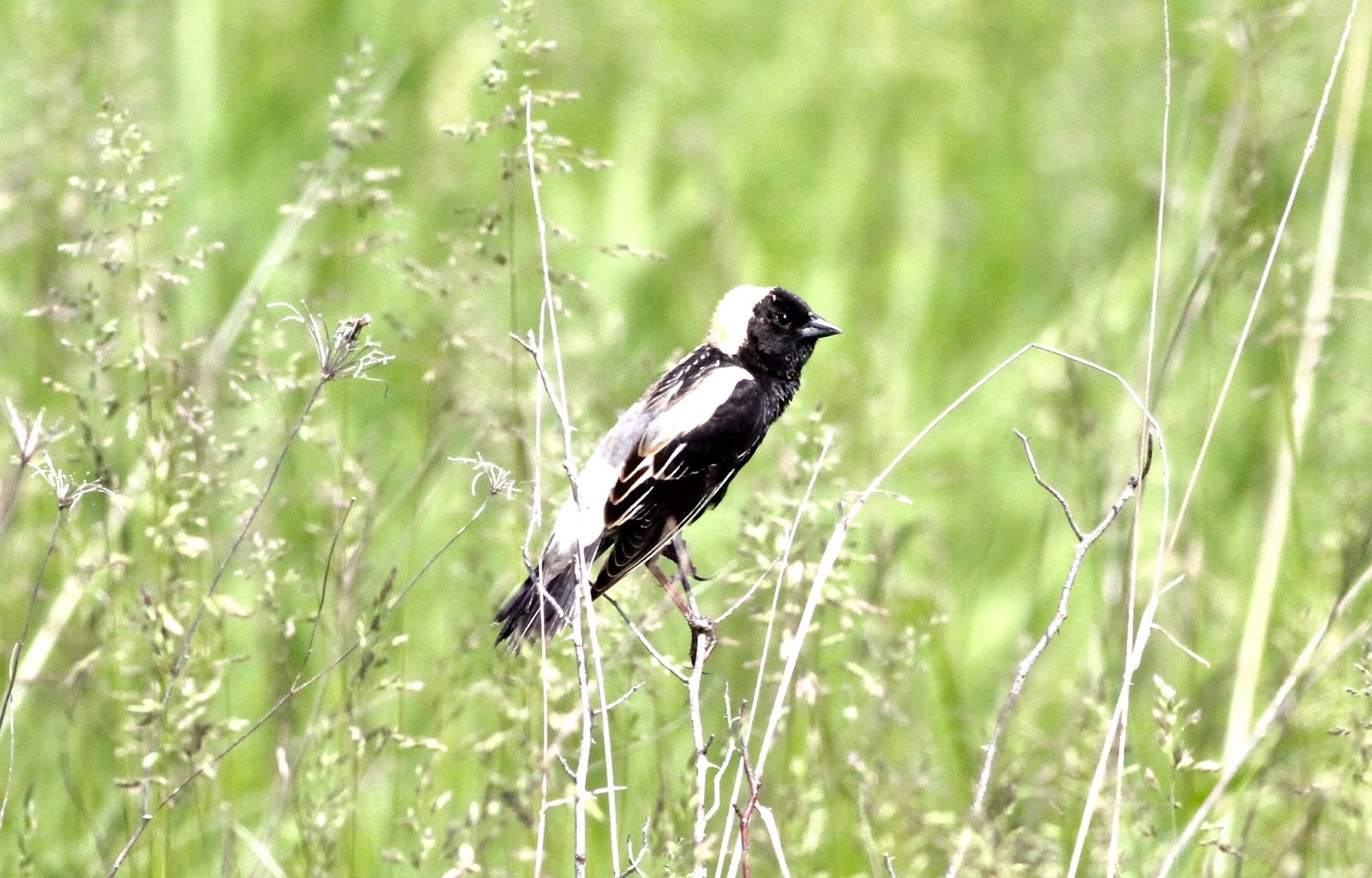
Bobolink and Grasshopper Sparrow


So after the craziness, back to a more stable routine.  This morning I got up at 5am and went to the gym, ignoring reports of Bicknell's Thrushes (which I never see anyway).  Feeling like I'm pretty much caught up now so I can focus on rarities and travel and don't need to be running around quite so much.

And as of today - New York State Year List 2017 = 257 / Rank 9
World Year List 2017 = 917 / Rank 27

Postscript:  within days of my writing this, and stopping the mid-week birding and going back to work (and the gym) both a Swanson's Warbler and a Henslow's Sparrow showed up in or close to the City.  I've seen both before in New York but both are VERY good birds here and I wasn't able to go and see either.  Oh, and several Bicknell's Thrushes showed up too .... you can't see everything ....