Sunday, March 25, 2018

The Lark Loop

A Visit to the Highveld Grasslands of Mpumalanga, South Africa

Over the years, you see a lot of habitats and a lot of wildlife on nature shows on TV.  A lot of the shows on Africa look a lot like the last post, Lions and Elephants in thorn scrub habitat, but there are some places that look very different, and one in particular I'd always wanted to visit.  The Highveld habitat is a special place.  Higher altitude grasslands, scattered with small Afrikaner farming communities, and filled with interesting and different birds.  It's hard to think of anything quite like it, so three days based in Wakkerstroom exploring this habitat was a trip I had been looking forward to for some time.


Sunday, January 7th / Monday, January 8th ... Wakkerstroom Area

We were staying at a lovely little guest house on the outskirts of Wakkerstroom.  South Africa prompts an odd series of emotions and Wakkerstroom, a pretty little Afrikaner farm town with neat little houses and beautiful gardens, prompted more than a few.  Outside of town, the "africans" (as the locals call them) still lived in a densely packed, and somewhat basic township with cinder block and corrugated iron 'houses'.  It may not have been surrounded by a fence any more but the contrast between the housing there, and the beautiful manicured grounds and accommodation at the place we were staying was quite jarring.  At dawn on day one, we drove over to the 'african' neighborhood to pick up our local guide for the day, the famous and talented Lucky.  Then off for a full day of birding the local hotspots.

White-bellied Bustard
Southern Bald Ibis
First stop was a location for WHITE-BELLIED BUSTARD and we quickly picked one up while driving across the short grass area where they breed.  Bustards were very much a key theme of the grasslands and not long afterwards we found ourselves searching for DENHAM'S BUSTARD and getting some distant scope views.  The third bustard species, BLUE BUSTARD had to wait until the next day but hey, any place with three bustard species is hardly horrible.

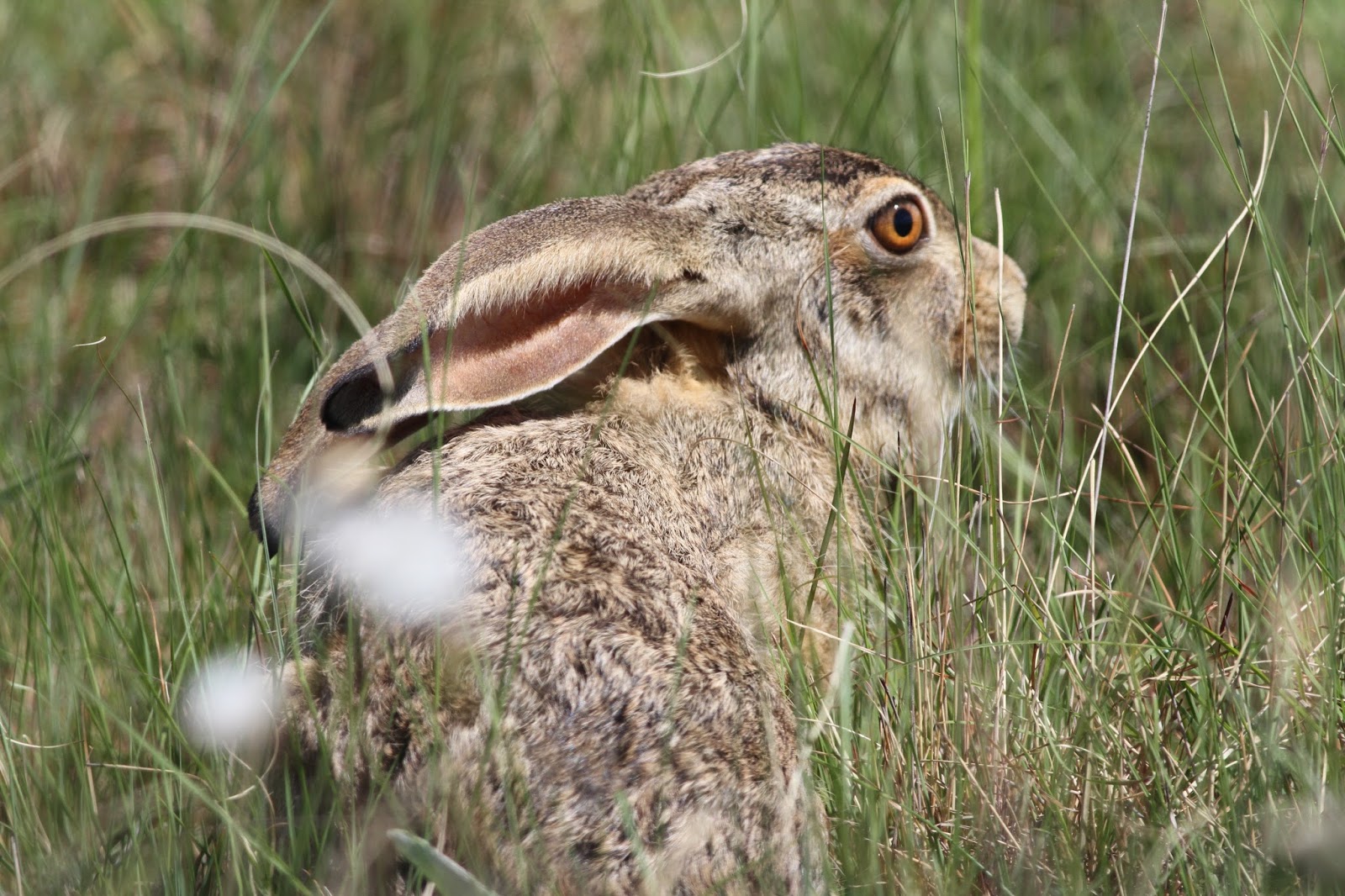
Mammals weren't really a target up here but we did see Meerkats, Yellow Mongoose, Scrub Hare, Springbok, Blesbok, Common Duiker, an Oribi, Mountain Reedbuck and a SERVAL, only the second one I'd ever seen.  Not a bad haul for a place not famous for it's mammals.

The bird I most wanted to see in the grasslands though was the BLUE CRANE the odd-looking, but strangely beautiful grassland crane of Southern Africa.  We saw a couple in the extreme distance while looking for bustards but I had to wait a while before we bumped into a pair with a young chick closer to the road.  The birds didn't panic when we stopped to take photos but they did walk away quite quickly so all I got was photos from the back.  Such an amazing species though, still my Facebook cover photo three months later.

Blue Crane family
Wakkerstroom is famous in birding circles not for these amazing big birds though, but for a series of small cryptic songbirds that spend their days hiding in the grass.  A half dozen species of lark can be found here but two of them RUDD'S LARK and BOTHA'S LARK are very rare and very hard to see anywhere else.  So generations of birders have come here to look for larks and with expert guide Lucky along for the ride, we planned to as well.

The spot for Rudd's Lark was an huge area of grassland with a few cows and couple of small building, and after stopping at a small farm to pay a fee, and stopping to flush an African Snipe from a small wetland, we got down to the serious business of lark-hunting.  Lucky clearly knew where a pair or larks preferred to be, so stopped in an area of grassland and had us form a line (of three birders) and walk through a specific area looking for find the larks.  45 minutes, and many passes later, no larks.  So we gave up on that pair and started working more broadly across acres of seemingly identical grasslands.  We saw Spike-heeled Larks, Red-capped Lark, various cisticolas and African Pipits (all similar-looking small brown birds) but no Rudd's Lark.  The only excitement came after about an hour and a half when we flushed a HOTTENTOT BUTTONQUAIL a very special and unexpected species.  Finally though, we were forced to admit defeat, deciding to try one more time at the original spot before moving one ... and of course there was a RUDD's LARK right where we'd started two hours before.

Rudd's Lark 
Scrub Hare, looking terrified ...
Botha's Lark
By contrast, the search for BOTHA'S LARK was straightforward.  We went to the site, got out, formed a line and walked no more than 30 yards before we found a pair on the nest.  Still a very good bird though.

Jackal Buzzard and Ground Woodpecker 


With the larks in the bag, and many other grassland species besides, we had time to look for a couple of species I really wanted to see at the Waakerstroom Wetlands.  My Rockjumper guide, Selwyn Rautenbach had done some important work on the super-rare and near mythical White-winged Flufftail, the rarest member of a family I'd seen precisely none of to date.  While we were talking about it he mentioned that Red-chested Flufftail lived in the local marsh ... did I want to see it?  Duh!  Of course I did.

So we spent a fair amount of time at the marsh seeing a good selection of water birds and even a big Nile Monitor lizard.   Gray Crowned-Cranes were here as were African Rails and African Marsh-Harriers, a truly birdy spot.  Playing tape for the flufftail I kept my fingers crossed then saw just hint of movement in the grass ... and there it was ... a female RED-CHESTED FLUFFTAIL, my first flufftail.  Hopefully not the last ...

Red-chested Flufftail ... well I was excited.
The night wasn't over though and we ended the birding by calling in an AFRICAN MARSH OWL.  When I was a kid I looked at the species in the Peterson Field Guide to the birds of Europe, the Middle East and North Africa (they just get into Morocco) and had always wanted to see one.  Magical way to end the day.  And who knew, there was even a decent restaurant in Waakerstroom ... so some cocktails and a delicious meal to end the visit ... who could ask for more?


Saturday, January 27, 2018

Photospot: Mammals of the Kruger National Park

Some Mammal Photos from my January Trip to South Africa

Spent part of four days in the Kruger National Park.  Lots of birds (to follow) but here are some of the mammals we saw.  Some of these need no labels ....


On the first few days we saw no Rhino and I was worried that the poachers (who have apparently been very active, even in the park) had killed them all off.  On the last few days though we saw a total of 7 White Rhino.


Every guide wants to get you "The Big Five" and with Elephant and Rhino, we needed Lion, Buffalo and Leopard.


And then there were other critters ... Steenbok, Klipspringer, Dwarf Mongoose, Spotted Hyena.


And finally, Vervet Monkey and Warthog.


Other mammals in the Kruger included some night drive mammals - Lesser Galago, Thick-tailed Galago, White-tailed Mongoose, Red Tree-Rat, Scrub Hare, African Civet and Large-spotted Genet.  We also had Blue Wildebeest, Giraffe, Hippopotamus, Slender Mongoose, Banded Mongoose, Black-backed Jackal, Burchel's Zebra, Waterbuck, Bushbuck, Chacma Baboon, Lichtenstein's Hartebeest, Impala, Kudu, and Tree Squirrel.

Away from the Kruger we also added Black Wildebeest, Common Duiker, Eland, Mountain Reedbuck, Meerkat, Nyala, Oribi, Rock Hyrax, Serval, Springbok, Tseessebe, Blesbok, and Yellow Mongoose.

Total of 46 species of mammal ... better than some birding trips I've been on.

Tuesday, November 7, 2017

November Magic in New York

Fall Migrants and Vagrants in New York, including an *Mega* Rarity

October was a terrible birding month.  After the excitement of the Lark Bunting and the Brown Booby in September, I basically saw nothing very interesting in October.  Not that I didn't go out; I spent three weekends birding on Long Island and saw, well very little of note.  So on to November, the traditional time for rarities and surprises .... and I was feeling that I could really use a couple of both ....

Saturday, November 4th - Suffolk / Bronx Counties

Friday night, and after the boredom of October birding on Long Island I was looking for something else to do.  Should I spend Saturday hoping that the New Jersey Common Greenshank was still around, even though it hadn't been seen for a few days?  Should I do a ludicrous 15-hour round-trip drive to Niagara Falls for a recently reported Sabine's Gull (a New York State bird for me)?  In the end, I got up late (6am) and made do with another trip to Long Island.  This time though, at least there were some birds.

First stop was Heckscher State Park, where a nice range of late migrant shorebirds had been reported during the week.  My main target was Hudsonian Godwit, a Suffolk County bird for me and sure enough I pulled up to the puddles in the parking lot and immediately saw three of them feeding there along with a nice selection of other shorebirds and ducks.  

Hudsonian Godwits and Northern Pintail

Wondering what to do next, I decided to push further East and ended up birding for a couple of hours along Dune Road in Hampton Bays.  Nothing too amazing here but lots of birds ... Peregrine Falcons, Merlins, returning Common Eiders, Sharp-tailed Sparrows, the change of seasons was very obvious and the weather was clean, bright and autumnally crisp.  A very refreshing place to spend the middle of the day, in fact I was really liking this birding thing again.  I was having so much fun in fact that I though about going on the East Hampton to stay the night and bird Sunday Out East as well.  In the end though, the lure of the Sabine's Gull got the better of me and I doubled back to the City, stopping at Seatuck Creek (and finding a Eurasian Wigeon) and at Orchard Beach in the Bronx for a Black-headed Gull.

Peregrine Falcon (above) and Merlin (below) 

Black-headed Gull, my first for Bronx County
Sunday, November 5th - Niagara Falls

When I got home on Saturday night I saw that the Sabine's Gull at Niagara Falls had been seen again during the day, and so decided to give in and follow my instincts and try to see it.  I ordered the car for 3am, texted Greg Lawrence for advice and then, when he said he wanted to tag along, made plans to meet him near Rochester the next morning.

By 3:15am I was on the road.  I picked up Greg at around 9:30am near Rochester and we arrived at Niagara Falls by 10:45am .... easy!  I had good directions for local expert Willie D'Anna, who's partner Betsy Potter has found the bird a few day earlier, so we went straight to Goat Island then walked down the steps to the Luna Island observation platform perched right on top of the American Falls.  Here we took our place among the tourist but while they were all taking selfies with the falls in the background, we were staring straight down into the churn of water, foam, mist and shattered rocks at the bottom of the falls, the place where the gulls feed.

Lot of Bonaparte's Gulls... thousands of Bonaparte's Gulls ... then a Little Gull .... then after a half hour of scanning the Bonaparte's Gulls, Greg picked out the SABINE'S GULL (NYS #399).  What a beautiful bird, and a New York State life bird.  Not an easy bird to find in New York, they migrate through in small numbers but rarely stick around, so a bird that could be chased was a rare thing indeed.  That was in part why this particular bird had haunted me all week, and even though it was far away in terms of hours driven, I was glad that I went to see it.

Sabine's Gull (above) and with Bonaparte's Gulls (below)

So I felt pretty good, and even though we failed in an attempt to add a Franklin's Gull in Buffalo later,  and even though I had to drive for 7+ hours to get home (and it rained all the way), I came home happy and feeling accomplished.  How could I possible top that, even though Greg had said something that stuck in my mind ... "November is when all the weird rarities show up" he said ... so may be there was a chance of another new bird.  But what could top a Sabine's Gull?

Tuesday, November 7th - Suffolk County

I felt like crap all morning.  I was sick with something and not feeling at all well, even throwing up a couple of times at the office.  By noon I decided to take the afternoon off and headed toward the apartment only to check messages on the subway and see one from Anders Peltomaa asking for a ride to the Corn Crake if I was going .... CORN CRAKE!!!!! What the hell ...

I jumped across into the birding listserves and sure enough, Ken Feustel had found a Corn Crake in Suffolk County (my home county) that morning.  As unwell as I felt, I knew I was going to go for it so I ran home, went up to the apartment, made a bathroom stop, grabbed the camera, made another bathroom stop, jumped in the car and headed out.

There has not been a chaseable Corn Crake in North America .... ever!  The last record from New York State was 60 (!) years ago, and the one before that was 75 years earlier.  The two recent records in Eastern North American were of a bird killed by a cat, and a bird mis-identified and only correctly re-identified from photographs several years later.  This is now a rare bird in Europe where they normally live, and there were basically only two living North American birders who had it on their US list ... until today ....

The drive out was short (in reality) and endless (in my head), not helped by my feeling terrible and coughing and spluttering all the way there.   When I finally reached the spot, parked and rushed over to the gathered birders, Isaac Grant told me that the bird has been visible but had been spooked by a car and vanished into the undergrowth ..... argh!!!!

So the next 10-15 minutes were, shall we say, tense .... there's nothing quite like standing with  group of birders who've seen a rare bird and are chatting away about how wonderful it was, when you haven't yet seen the bird (!).  But my luck help up and before long, the bird nonchalantly wandered back out onto the grass verge and unleashed a storm of shutter sounds from the gathered birding paparazzi.  CORN CRAKE .... NYS (#400) .... amazing.  Then I drove home and passed out, seriously worried that I might have pneumonia ... I was gone for only a couple of hours ... but I now have Corn Crake on my New York State list, so if I die, I'll die happy!

Corn Crake

And we're still only in the second week of November ....  and we weren't done yet ...

Monday, November 27th - Central Park

After spending the Thanksgiving Weekend in Montreal, I got back to New York on Sunday night to hear chatter about a potential Hammond's Flycatcher in Central Park, incredibly right in the same area that had hosted a Pacific-Slope Flycatcher a few years earlier.  So up at dawn and into the park where I joined a small group of birders and got but a fleeting glimpse of a bird that looked good but didn't stick around for photos, before I had to go to head to the office for work.  Luckily though I had a light schedule so planned a long lunch and headed back to the park where a large crowd of birders had now gathered and I got much better views of another New York State bird for my list ... HAMMOND'S FLYCATCHER (#401).

Hammond's Flycatcher - Photo: Nathan Goldberg (used with permission)
Luckily Hammond's Flycatcher are a great deal easier to identify than Pacific-Slope / Cordilleran Flycatchers so the ID was quickly established.  This was only the 3rd record of the species for New York State though, so a great bird, and one has to wonder what we miss every year in areas that get a lot less birding attention than Central Park.  November really had produced some good birds, including a trio of New York State birds for me, and so on to December with thoughts starting to turn to new adventures in 2018.


Sunday, October 15, 2017

Another Nemesis Bird Vanquished

Finally Seeing Brown Booby in New York State

Friday, September 29th - Suffolk County, NY

How do you decide what your nemesis bird is?  Is it the most common bird you haven't seen in a particular area?  If that were true, then my New York State nemesis bird would have been Mew Gull, which occurs annually and which I've searched for and missed often.  Or is it the bird you've missed, where the misses hurt the most?  I think I tend toward the latter, so after I finally caught up with Black Guillemot in New York this Winter, I decided that Brown Booby was going to be my new nemesis bird for New York State.

Why Brown Booby?  A long drive and a painful miss last Fall was still fresh in my mind.  Plus a bird that I could have seen but for a random change of plan a few years earlier and thus missed on my big year.  And of course,they're cool, in a goofy kind of way ... and I really wanted to see one in New York.

So of course when one showed up in New York, quite close to the City, this Spring .... I happened to be about 450 miles away at the other end of the state.  The bird arrived, and spent all day sitting at, the tern colony at Nickerson Beach giving almost every New York City and Long Island birder great views.  For a while I toyed with driving back overnight to be there in the morning, but the bird did not look well (being covered in tern poop is never a good sign) and sure enough it was found dead in the morning.  Another miss, but at least I hadn't driven all night to miss it.

I didn't think I'd get another chance this year, but fast forward to September and a Brown Booby was found in Montauk Harbor (30 minutes from my house, but unfortunately I was stuck in London then in New York City).  Then another potential state bird showed up nearby when Brent Bomkamp found a LARK SPARROW at Robert Moses State Park.  Two State Birds on Long Island and I was stuck in the City all week!

I decided that, as a grown up, I could keep perspective and wait until the weekend to chase these birds ... but this grown up resolve lasted until only about 10am on Friday, when my will-power evaporated and I jumped in the car and headed out in search of state birds.

Lark Bunting - Photo by Tom Reichert (used with permission)
Stop number one was Robert Moses State Park where the Lark Bunting had apparently been elusive and hard to find near the Volleyball Courts in Field 2.  I found the site easily enough and when I arrived expert local bird photographer Tom Reichert was on site and had just had the bird (!).  A few minutes later it popped up again and I got great views, and what turned out to be terrible out-of-focus photographs .... birders call them "Record Shots" while photographers are much more patient.  So LARK BUNTING joined the New York State list (#397) and I was off again in search of number 398.

Just for contrast, here's my best effort of a shot of the Lark Bunting ... note
how perfectly in focus the pine cones in the background are (!)
So on to Montauk, and the real target of the day.  About an hour later I pulled up onto Star Island Road on Lake Montauk and, following directions from the bird alerts, looked out to the mast of a nearby Yacht .... and there was a suspicious brown lump on top of it .... BROWN BOOBY!


The bird actually flew off fairly quickly and, figuring it would be better seen from South Lake Drive I drove down and sure enough the bird was sitting on another yacht mast, this one much closer to shore.

Brown Booby, Montauk

So two New York State birds in one day, and a little closer to my goal for 400 species in New York State.  The rest of the weekend, and indeed the next few week were anticlimactic after these two star birds, but this at least was a great birding day on Long Island.

American Golden Plover on Long Island


Monday, September 25, 2017

Rock Partridges, Rock Nuthatches and Ancient (stone) Temples

A Weekend Birding in Greece

So what to do when you find yourself with a free weekend on a business trip to Europe?  Not the most productive continent for potential life birds for me but it gave me a chance to go somewhere interesting, and if I could add a few life birds while I was there, so much the better.  After considering several possible countries - Spain? Portugal? Tunisia? - I settled on Greece, and flew down to Athens for two days of birding with Lefteris Stavrakas a local hot-shot birder who'd arranged a quick hit trip for me focussing on a handful of possible life birds.

Friday, September 22 - Sounio, Messolonghi and Kleisoura Gorge

We started the trip at dawn on day one birding near the Temple of Poseidon on rocky slope overlooking the Agean Sea .... how perfect a start to a Greek birding trip was that?  Our target here wasn't very exciting, but we soon managed to find a family group of Chukars (Life bird number 4,030) and duly added it to my life list.  Chukar is a widely introduced game bird (for shooting) and can be found across Europe and the American West ... I'd just never managed to bump into one.  These Chukars were introduced too, but common and established breeders (they occur in their native range on the near-by Greek islands and were introduced to the mainland when the native Rock Partridges got scarce due to hunting pressure) but I had to count one for the list at some point so I chose to take these for my life birds.  I felt a little dirty, but got over it and moved on fairly quickly, after all, I'll never have to life list Chukar again..

Next stop, after a longish drive, was the lagoon complex at Messolonghi which was simply stuffed with birds.  Shorebird migration was in full swing and we saw 22 species of shorebirds, including Broad-billed Sandpiper, and a wide range of waterbirds of various sorts.  My target bird here was Dalmatian Pelican (4,031) and we quickly saw four of these giant waterbirds along with a lot of ducks, terns, gulls, flamingos and a good scattering of migrant passerines.  A very birdy spot indeed.

Dalmatian Pelican (above) and Greater Flamingo

I also got my third life bird of the trip here when we tracked down some Western Rock Nuthatches (4,032) near the fascinating mud nest they'd presumably used this year.  This species was common and very vocal here, indeed we saw or heard a lot over the weekend, but seeing them around their amazing mud nest was a great way to add a species.  A very cool bird.

Western Rock Nuthatch and Western Rock Nuthatch nest

Black-Eared Wheatear
Last stop of the day was a stake-out (I haven't been doing well at stake-outs recently) where a Cinereous Vulture had been roosting with some Eurasian Griffons (Vultures) on the cliffs at a gorge.  We gave the bird a lot of time, enjoyed great views of the Griffons, increasingly rare given the global vulture collapse, and saw a good range of other raptors.  Our target bird however, did not show up, maintaining a tradition of me not seeing this species in places (Spain, China, etc.) where I could have done so. Ho hum ....


Saturday, September 23 - Nafpaktos, Kopaida, Athens

After spending the night in the grandly named, but rather basic, Hotel Aphrodite in Nafpaktos (not that I cared, I could have slept anywhere at that point I was so tired), we got up early and headed East along the coast road hoping for two more of my target birds.  We stopped at a small village and started birding the rocky cliffs and olive groves around it hoping for one target but quickly lucked out with another one when a very vocal Sombre Tit (4,033) popped up in an olive tree.

Bad record shot of a Sombre Tit
Pushing uphill we played recordings of what we though might be the most challenging target bird of the trip - scarce, heavily hunted and therefore very shy - and were rewarded (and a bit shocked) not long after when a Rock Partridge (4,034) called back.   Now all we had to do was see the bird .... somewhere up on a vast rocky slope above us.  In the end, persistence paid off and I caught a glimpse of movement well up the hill-side and was able to train the scope on a clearing in time to see a family group of partridges scuttle through it.  I was thrilled at the sighting, but mostly relieved that I didn't have to climb that slope to look for the birds.  Definitely the highlight of the weekend for me.

Can you see the Rock Partridge in this photo?
The Rock Partridges turned out to be the last lifer of the trip.  We spent a lot of time at the Plain of Kopaida looking for, and not seeing Long-legged Buzzard (although we saw a lot of other birds) and hit some coastal and woodland spots in search of year birds for me.  In all we saw 112 species, 5 life birds and 76 year birds, not bad for a weekend.

Red-footed Falcon at the Plain of Kopaida
By the time I got the Athens airport I was exhausted.  Two full days of birding on not a lot of sleep and a long flight back to New York ahead of me.  I guess I'm not as young as I used to be, but was it worth it?  Yep, it certainly was ....