December 2019: A Few Days at the Canopy Lodge over New Year's Eve/Day
I wanted to go somewhere wild and natural for New Year's Day 2020; it's always good to start the year list somewhere exotic with the prospect of a large list of birds on the first day of the year. Starting the year in New York is OK I suppose, but American Crow and Herring Gull as the first two birds on the list just isn't all that exciting year after year. So I always try to be somewhere a bit more exotic these days ... 2019 was Ghana, 2018 was South Africa. For January 1st 2020 I had planned to be in Brazil but somehow plans were just not coming together. I worked on options for several weeks and slowly realized that I just wasn't getting anywhere. Frustrated, I was about to give up when I saw an email from the Birding Tour Company
Field Guides offering last minute spaces on a week-long trip to the
Canopy Lodge in Panama. "Why not?" I thought. Jesse Fagan was leading it, a great birder and a really interesting character who I'd met a few years ago in Peru. I'm generally not a great fan of group tours but this sounded like it might be just fine ... a low key week in a nice lodge, the chance for a good handful of lifers, and no hassle as Field Guides would take care of everything. "What the hell" I thought ... I was in ...
Saturday, December 28 - Panama City
Panama really isn't that far away. A five hour direct flight from New York and you're right there and close to a lot of good birding spots. I hadn't been to Panama since a trip to the Darien in 2003, a remarkable roadless area where we'd hiked Cerro Pirre for the local endemics and stayed at an old mine camp in a forest thick with life. A quick look at my 'needs list' for Panama on eBird gave me an encouraging list of 75+ possible lifers but by the time I broke them down by province and season, then further whittled them down in reference to the Field Guides trip list, it looked like I had about 20 realistic possible life birds ahead. An interesting number though because at the time my life list was 4,980 ... would I make 5,000 on this trip? It seemed a stretch but it was certainly intriguing.
After meeting up with Jesse at the hotel, or catching up really, we met the rest of the group, all of whom seemed to be professors from U.C. Davis and were traveling together. I was definitely the odd one out here, and Jesse had been a little surprised to see me sign up for a group trip but I reassured him I was just there to chill, no expectations, I was filling in an open week and happy to see what I saw. And so a nice dinner, group introductions, and we were ready to start birding early the next morning.
Sunday, December 29 - Panama City to Canopy Lodge
Not everyone on a group trip has made dozens of previous trips to the Neotropics it turns out. So group trips tend to start slow to give participants a change to acclimatize to the birding conditions, get familiar with the common birds and get into he swing of group birding. We started out with a very pleasant morning walk in Park Natural Metropolitano in Panama City itself and had 35 species of (mostly) common birds and some Central American Agoutis while we 'worked out the kinks'. The group wasn't terribly hard core but they were all smart and interesting people and capable and keen birders so I figured the week was going to work out just fine.
The drive out to the lodge actually wasn't that long in the end and soon we'd all settled in to our very nice rooms and were familiarizing ourselves with the local birds. Some very familiar faces here; Louisiana Waterthrush and Summer Tanager on their wintering territories, but also some decidedly tropical looking birds like Golden-hooded Tanagers. The lodge grounds are quiet lovely and very birdy, so not a bad place to spend a few days.
 |
| Summer Tanager |
After dinner that evening, conscious no doubt that some of us were super primed to keep looking at wildlife, Jesse offered an optional night prowl. In the end only a couple of us took him up on it but it produced some goodies. I scared the life out of a
Central American Woolly Opossum in a tree near the lodge when I turned on my spotlight ... who knew they could move so fast? We also spent some time with the
Orange Nectar Bats that came to the hummingbird feeders are night before taking a UV light and going on a scorpion hunt, ultimately rewarded with a half dozen individual scorpions including a pair involved in some sort of mating activity.
Monday, December 30 - Canopy Lodge and La Mesa RoadOur first proper day at the Canopy Lodge and a relaxed and bird-filled start to the day. We drove a ways up the La Mesa road and stopped in an area of gardens and fields where the trip list quickly burgeoned with the common forest-edge birds for the region. Once sated we got more serious and proceeded up to the La Mesa trail where we walked several kilometers along the ridge-line trail, checking each of the forest patches for whatever might linger there.
The way out produced nothing terribly exciting save for a quick look at a life
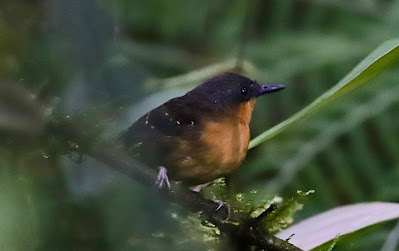
Emerald Tanager for me, the local guide, and a couple of lucky group members. The way back however, proved far more interesting when one of the Davis crew, who had been lagging back, described an interesting bird she'd seen hopping around in the undergrowth. Mindful of the possibility of
Black-crowned Antpitta, we circled back and worked our way into a narrow strip of forest between the road and a farm field and sure enough, there it was, skulking craftily in the dense undergrowth and allowing only brief and fragmented views. But what a bird ... this pittasoma is a dumpy, tail-less, thrush sized bird with a round body, huge bill, and and endearing habit of bounding from perch to perch in the understory. The black cap is striking, mostly for sitting atop a rich rufous cheek, and the the chestnut-brown back contrasts with pearly-white underparts scalloped with bold back half-moon patterns. It really was very special bird and one of my key targets for the trip ... a perfect end to the fist morning.
After lunch and a siesta, we headed out again and worked some gardens, fields and woodland at a housing development called Casa Iguana. Not the most pristine of habitats but it was birding and came with the added bonus of a stakeout
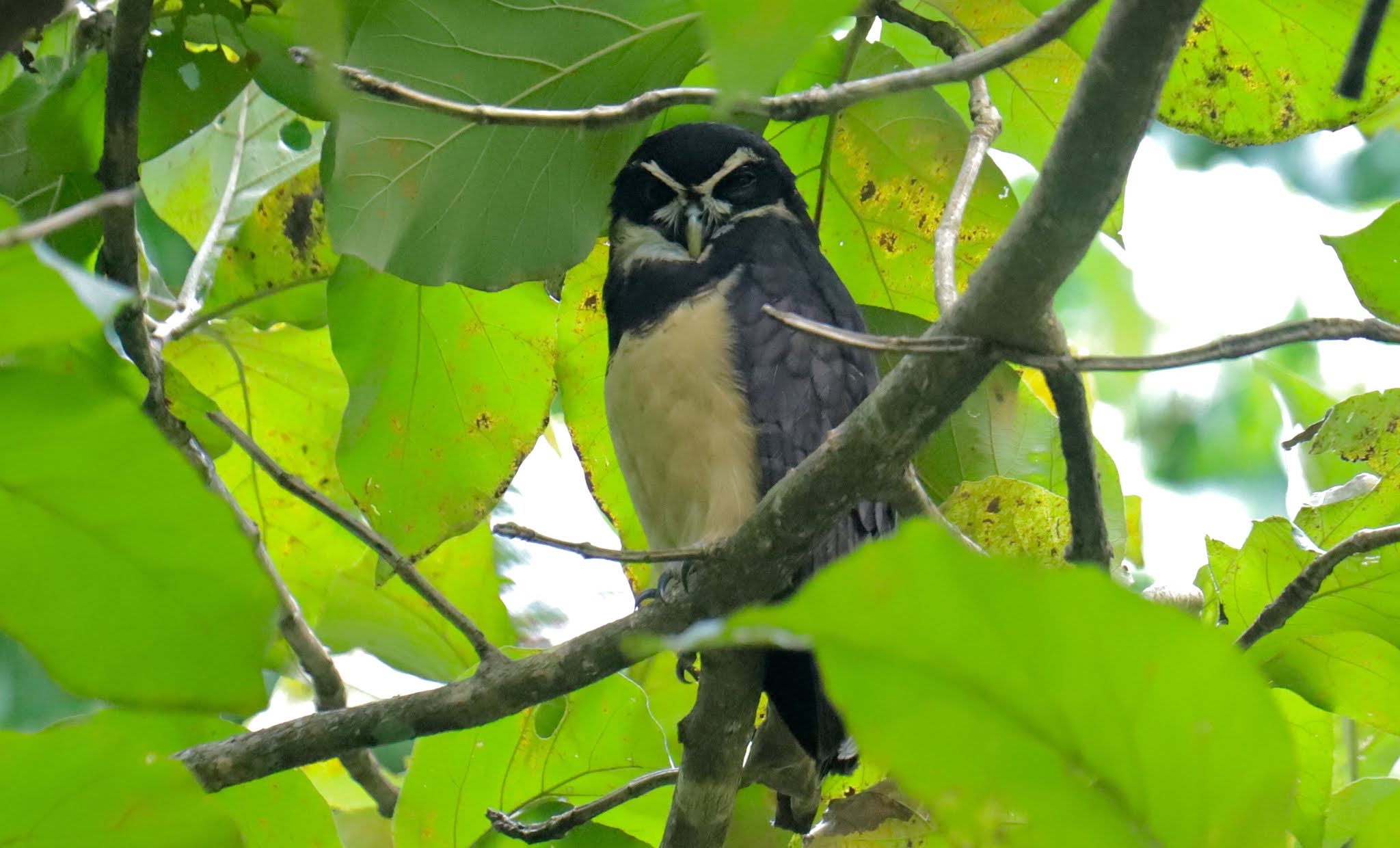
Spectacled Owl, a big lump of an owl and strikingly patterned. I'd seen this species before but I never tire of seeing owls during the day so quite a treat. The fields and empty building lots also yielded a lifer me me ...
Garden Emerald ... not the most exciting of hummingbirds but hey, still a lifer.
 |
| Spectacled Owl |
Tuesday, December 31 - Altos del MariaAfter yesterday's great start we had great expectations for the trip 'up the mountain' to the higher elevation forests at Altos del Maria. The region seems a popular area for wealthy Panamanians to build second houses and we birded largely from a road network that criss-crossed the forest to accommodate luxury housing on large lots. The only thing missing were the houses, which for whatever reason had never been built, or at least had not been built yet. Putting such thoughts aside though, we started to get to work on looking for the various specialties that could be found here, which included a half-dozen potential lifers for me.
First up was a quick stop at a known lek site for
White-tipped Sicklebill, a spectacular streaky hummingbird with a remarkable bill designed for feeding on the deeply curved flowers of heliconias. The bird was exactly where the local guides said it would be so was quickly scoped and added to the lists and we pushed on, ignoring the ominous signs on impending rain, in search of more.
Further up the road another successful forest stop yielded great looks at two shy and difficult-to-see forest birds, both of which were new for me. The
Streak-chested Antpitta sat in the open and allowed itself to be scoped, while after a little more work, a
Purplish-backed Quail-Dove allowed itself to be seen peaking from the undergrowth in response to our tape.
 |
| Purplish-backed Quail-Dove |
So we were on a roll and turned our attention to a new site where we thought we'd heard the enigmatic Rufous-browed Tyrannulet, a tiny bird with an odd, patchy, range stretching from Costa Rica down to Ecuador. It was a lifer and I really wanted to see it ... and then the rain came.
I admit that I am stubborn, and so quite happy to ignore anything but the most inclement of weather, especially when I think I can hear a life bird. I was very focussed on the tyrannulet and also on a Snowcap, another lifer, that I glimpsed briefly at the same site. As the rain got heavier and heavier though, even the most polite and accommodating for my birding companions slowly gave up and drifted back to the van. When the rain reached truly thundering proportions, and I was standing alone in the deluge, utterly soaked, and quite unable to hear or see much in any case, eventually even I had to give up the ghost and surrender. There would be no more birding that day (save for some civilized squirrel-watching, beer in hand, at the lodge feeders) and I fretted about how long this seemingly endless rain would last. We only had a few days and I'd heard or glimpsed two lifers but been denied by the weather, I could feel the chance of 5,000 slipping away.
So what would my first bird of 2020 be? In the pre-dawn light I could hear a lot of birds, even had some idea of what some might be, but decided to wait on a bird I could actually see. In the end,
Rufous Motmot stole the prize, swooping in to the feeders in the dawn light ... and we were off for 2020!
 |
| Rufous Motmot ... my first official bird of 2020. |
The next question was what would my first lifer of 2020 be? And that was answered an hour later on the trail at Cerro Gaital where I saw and heard my first ever
Spot-crowned Antvireo. Not a bad way to start the year and in fact this trail was very birdy yielding nice views of the skulking
Black-faced Antthrush, a novelty
Brewster's Warbler, and even a
Hoffman's Two-toed Sloth for extra measure.
 |
| Northern Schiffornis |
The bird continued later in the day at Camino La Mesa - Rio Indo with a nice mix of birds including an assortment of 'ant-things' and a spectacular Brown-billed Scythebill. Then back to the lodge for siesta and back at it for post siesta birding in another area of fields and forest edge to flesh out the list.
 |
| Brown-billed Scythebill in the darkness of the forest |
Thursday, January 2 - Bosque del Galicia / Altos del MariaStarted the day back up in the clouds in the higher elevation forest where I quickly added my life White-vented Euphonia among a lively mix of birds that included good looks at Black Guan, Northern Emerald-Toucanet, Spotted Barbtail and even a few friends from home like Blackburnian Warbler. The highlight as we left though was a perched female Snowcap doing it's best to make up for the terrible views I'd glimpsed of the male in the rain a few days earlier.
 |
| Snowcap ... the males are flashier, but this one was cute ... |
Leaving the pristine core of the forest aside we paid a visit to a landscaped mini-golf-course area nearby and were immediately rewarded with two lifers for me ... the
White-tailed Emerald and the
Rufous-browed Tyrannulet ... I guess if you leave the big trees and patches of the native woodland, the good birds can cling on.
One bird I really wanted to see what the tiny
Rufous-crested Coquette ... a very ornate hummingbird that was reputed to visit the flowering trees back at the lodge. I'd already invested several hours watching those tree when I really should have been enjoying my siesta but with no luck. Today though, the weather was on our side, and as the sun broke through the clouds and the rain held off, our local guide spotted a coquette sitting out in the open near a small lake and we all enjoyed long leisurely looks. And I enjoyed an uninterrupted siesta.
The evening birding at Valle Chiquito was kept adding more species and actually took us to a four Motmot day ... Rufous, Lesson's, Broad-billed and Tody ... very appropriate for a tour lead by Jesse Fagan who goes by the nick-name of "motmot" in the birding world.
 |
| Collared Trogon |
Friday, January 3 - Drive back to Panama CityFriday was a travel day but we took the 'scenic' route back with a number of stops in different habitats to fill out the trip list. At one of them I got my final life bird if the trip ...
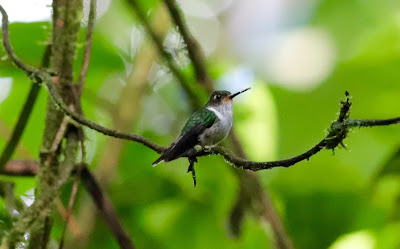
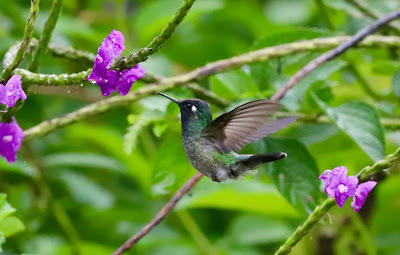
Veraguan Mango ... bringing my life list to 4,997 and meaning that 5,000 would have to wait for the next trip.
We ended our birding at a delightful beach stop and picnic near Santa Clara where we added a few loafing terns and sea birds, some lovely views of the Pacific, and got to savor a great week of birding with some good food and a cold cerveza ... who knows, maybe I'll do another group trip one day ...