Showing posts with label Central America. Show all posts

Saturday, July 22, 2023

Crocodiles and Emeralds

 February 2022: A Couple of Old Welshmen Bird Honduras

The second of the two 'big company' birding tours I booked at the 'end' of COVID.  After the disaster that was the Ecuador trip, I headed out again with some trepidation, but went anyway ... life is too short ...

Friday, February 11 - Tegucigalpa

I have to say this city name makes for a great Facebook post so I put my 'Traveling to Tegucigalpa' status up along with 'let's try this again' and off I went.  The airport worked just fine but the drive through the city to the Hotel Gloriales was long and slow.  Still, it gave us time to get acquainted and for me to catch up the Steve N.G. Howell, who I've know since we were teenage birders in Wales in the 1980s, but rarely get to see any more.

The hotel was lovely.  They had puppies and good birds in beautiful gardens.  What more could you want?

Saturday, February 12 - P.N. La Tigra

Ah, that much anticipated first 'proper' day of birding in a new country ... there's nothing like it.  Today started out well and I even had a trio of life birds in the morning.  Highlight number one though wasn't a bird at all but a rather well-camouflaged Wilson's Montane Pitviper lurking in the leaves a the visitor center ... careful where you sit people (!).

On the bird front, the highlights for me were my life Green-breasted Mountain-gemsGolden-cheeked Warblers (hey, I've never been to Texas in Spring!) and Slate-colored Solitaires.  There were lots of memorable species to see here though including Resplendent Quetzal, Pale-billed Woodpecker, White-breasted (Sharp-shinned) Hawk, Mountain Trogon,  and lots of Northern Emerald Toucanets.

Wilson's Montane Pitviper

Perhaps the most interesting bird though was not (yet) a lifer ... we saw the very rare local form of Black-banded Woodcreeper.  This particular form occurs here and in Southern Mexico (where is is practically unknown) and is almost certainly a separate species from the forms that occur in Costa Rica and in the Amazon.  Taxonomy in motion, one of the most fascinating parts of the world-birding experience.

Black-banded Woodcreeper and Green-breasted Mountain-gem


In the afternoon we walked a long way down a relatively steep trail (I'm always hyper-conscious that you have to come back up these trails) to a weedy field at the edge of the park and there we spent some time with a Wine-throated Hummingbird.  These tiny little scraps of molten lava truly are a treat and even made the long slog back up the trail almost worth it.  This is why we travel, just a really memorable day of birding and nature with good company and a cold beer and good food to follow ...

Sunday, February 13 - Travel to PANACAM Lodge

A long travel day today but punctuated with some nice stops for some specific specialty birds.  

Fist up was an early morning stop at P.N. Unidas el Picacho, a sort of park, picnic area, and small zoo that I'm sure is a nightmare at noon on a Sunday but this morning we were here early enough that we had it to ourselves.  The highlight here was Ocellated Quail and we did indeed hear some but never close enough to have any chance of seeing one.  We did see Plain Chachalacas and Crested Bobwhite running around plus a lot of noisy White-fronted Parrots.  So a nice way to start the day, and onwards ... 

Lesson's Motmot

The next stop was mostly for me I think.  I needed White-lored Gnatcatcher and Steve had scouted out a location for them on the day before the trip.  The spot was not scenic, a bakingly hot, wind-blasted piece of badlands reminiscent more of S.E.Arizona than of Central America.  But the scouting had paid off and we were very quickly looking at a pair of gnatcatchers with bonus Cinnamon Hummingbird and a 'blink and you missed it' Lesser Roadrunner crossing the road.

Bad shot of a White-lored Gnatcatcher

That evening we eventually made it to the lovely PANACAM lodge, our base for the next three nights, and settled in.  Different birds here so all went to sleep excited for what was to come.

Monday, February 24 - Honduran Emerald Day

Honduras has only one endemic bird, the Honduran Emerald, and it's impossible to imagine coming here without seeing it.  Ironically, little was known of this species, or where to reliably see it, until relatively recently.  Now, however there are spots where you can go and it was our number one priority for the day.

Fist stop was the El Rancho Restaurant where we picked up our expert local guide (who owns the hotel and restaurant) and enjoyed some of the local birds in the light rain.

Then off to a 'secret' trail location that ended at a feeder strategically hung deep in the forest and a conveniently well habituated Honduran Emerald that popped up on cue and gave a good show.  OK, perhaps not a pure wilderness experience but we got the bird and the location is protected and carefully managed by and for the locals so not a bad thing overall.

It was also a pretty birdy spot so we spent an hour or so enjoying the locals, including Golden-winged Warbler, Red-throated Ant-Tanager, and a couple of singing Blue Buntings.  Then back to the restaurant for a very pleasant lunch under a terrace in the rain.  Mission accomplished.  

Berylline Hummingbird and Honduran Emerald 


The rain, unfortunately, while scenic (I do love a good rain shower) made for tricky driving, and this afternoon the roads had become particularly treacherous.  Cars and vans were slipping and sliding across, and off, the road all the way to our next spot.  As we got closer, we arrived at a long, reasonably steep hill that we had to climb and the van simply couldn't keep enough traction to get up there on its first four attempts.  Just when I was thinking we were going to have to re-trace our steps and go back to the lodge though, attempt number five proved to be a charm and we made it to the next birding spot (and there was much rejoicing).  

Reserva Natural Privada Luna del Puente is a truly lovely spot.  A working farm that produces shade-grown coffee and chocolate while preserving a number of forest patches for the birds, making it a very nice piece of varied habitat with a lot of bird diversity.  Steve's three favorite things on earth are chocolate, birds, and coffee so we took time to sample all three while we were there (happy to report that all were excellent).  On the bird front, we saw 50 species with the absolutely highlight being a cooperative Tody Motmot that posed for pictures in a forested gully.  Perhaps the perfect way to spend a rainy afternoon in Honduras.

I have a soft spot for Tody Motmots

Tuesday, February 15 - Lago de Yojoa

As a kid we sometimes used the phrase 'like going to the bird house at the zoo' to describe a wonderful morning of birding where you saw a lot of species in one place.  Of course, as a kid in Wales I doubt we ever saw more than 40 species in a day, while this morning I saw 94 species at one spot, the amazing, scenic, and very birdy Lago de Yojoa.  A truly satisfying morning of birding that combined a range of waterbirds, local residents, and a ton of Neotropic migrants including 16 species of wood warbler.  An absolutely great morning of birding.

Muscovy Duck and Chestnut-headed Oropendola


With no real plans for the afternoon birding session I opted to focus on a potential life bird for me and stake out a spot for Black-crested Coquette, a tiny canopy hummingbird that was known to frequent a couple of areas of flowers at the lodge.  The rest of the group, having shorter attention plans went off birding while I spent the next three hours staring at a couple of flowing trees and waiting for a coquette to pass through.  The wait ended up being a long one but almost three hours later a tiny, slow-motion, bee of a hummingbird buzzed through my clearing and I was able to get bins up and confirm it was the coquette.  Not the most exciting view, but good enough and time well spent (the group had nothing more interesting to report when they returned later).


Wednesday, February 16 - PANACAM Lodge / Travel to the Coast

With the targets basically and accounted for we had a quiet morning to kill at PANACAM before driving down to the Atlantic Coast.  In no rush, so we shared a leisurely breakfast with the local White-nosed Coati who came for her breakfast banana every morning.  Then we birded the lodge grounds, spending time at the canopy tower and enjoying scope views of Keel-billed Motmot among other things.  Sad to leave PANACAM but new species awaited.

White-nosed Coati waiting patiently for a banana.

Thursday, February 17 - Garden Botanico Lancetilla

Today was lower elevation, on the Caribbean Slope, and so we expected different birds.  Indeed, we did rack up an impressive list and a wide range of new species for the trip-list.  It would perhaps have been more but of the traffic which limited our ability to get everywhere we wanted to go and we ended up skipping some spots rather than spending a big chunk of the day sitting in traffic jams.

The morning stop was the Lancetilla Botanical Gardens, or more specifically the patches of forest surrounding it.  We birded the entrance road in the morning then some forest scraps near the HQ a little later.  Steve had done bird survey work here 30+ years before as a young bird-bum writing a field guide to the birds of Mexico and Northern Central America so he had good memories.  Although much of the forest in this area is sadly long gone, we did manage to pull together some nice things during the morning, including a Black Hawk-Eagle, a Uniform Crake, and a nice Thick-billed Seed-Finch.

Slaty-tailed Trogon

Lunch with hummingbird feeders?  Why not....  The rain had started again to the idea of sitting under a covered patio and enjoying our picnic lunch while watching an impressive feeder set-up at the defunct bird lodge didn't sound bad at all.  The place positively hopped with dozens of hummingbirds and swarms of Shining and Green Honeycreepers.  Nothing terribly unusual here but a really pleasant way to spend a rainy lunch time and then, just to round things off, we found a Lovely Cotinga by the van just as we were leaving.

White-necked Jacobin and Crowned Woodnymph


Green Honeycreeper

Friday, February 18 - R.V.S. Cuero y Salado (The Boat Ride)

A lot of group birding trips to Central America have 'the boat trip' where you putter at a leisurely place through the mangroves in a tourist boat and see Boat-billed Herons and maybe a Northern Potoo or an American Crocodile.  Other groups also inevitably see Agami Herons but I never see them because that species is my nemesis bird and, despite having taken maybe 5 or 6 of these touristy boat trips in good habitat, this species continues to elude me.  Non-birders will tell me about the boat trips they did while on their beach vacations in Mexico or Costa Rica and inevitably they will report seeing that 'special heron', 'you know the agave heron', the guide inevitably very excited to show it to them and everyone feeling like they got their money's worth.  I, on the other hand, am simply incapable of finding one ... not that I'm bitter ...

This trip was no different.  Boat-billed Heron (check), Northern Potoo (check), impressive American Crocodiles (check), Northern Tamandua (check) .... Agami Heron ... nope.

Northern Potoo and Russet-naped Wood-Rail (a life bird for me)


Bare-throatedTiger-Heron (note the lack of Agami Heron photos)

Yellow-crowned Night Heron and Boat-billed Heron


Saturday, February 19 - COVID Tests and Airport

Time to go home.  In the 'time of the COVID' that meant lining up at a regional health clinic for a 'little lobotomy' COVID test in order to get that all important -ve antigen paper that would allow us to board the plane and get out of the country.  The good news was that we all passed and so the process of leaving was simple.

You hear so much of the bad news about Honduras in the U.S. Press where desperate migrants escaping a violent dysfunctional country seems to be the accepted narrative. I have to say though that it doesn't feel that way on the ground.  Everyone we met in Honduras was super friendly and quite lovely, and while I know we were in a tourist bubble for some of the time, we also wandered the back roads and ranged widely across the country.  There are no doubt real problems here but it was fine to travel, we were welcome everywhere, and I'd certainly be happy to go back.  It was a very lovely break ... and I didn't catch COVID!

A 'real' American Crocodile, looks like it eats pirates' hands and unwary tourists ...


Monday, May 31, 2021

New Year's in Panama

December 2019: A Few Days at the Canopy Lodge over New Year's Eve/Day

I wanted to go somewhere wild and natural for New Year's Day 2020; it's always good to start the year list somewhere exotic with the prospect of a large list of birds on the first day of the year.  Starting the year in New York is OK I suppose, but American Crow and Herring Gull as the first two birds on the list just isn't all that exciting year after year.  So I always try to be somewhere a bit more exotic these days ... 2019 was Ghana, 2018 was South Africa.  For January 1st 2020 I had planned to be in Brazil but somehow plans were just not coming together.  I worked on options for several weeks and slowly realized that I just wasn't getting anywhere.  Frustrated, I was about to give up when I saw an email from the Birding Tour Company Field Guides offering last minute spaces on a week-long trip to the Canopy Lodge in Panama.  "Why not?" I thought.  Jesse Fagan was leading it, a great birder and a really interesting character who I'd met a few years ago in Peru.  I'm generally not a great fan of group tours but this sounded like it might be just fine ... a low key week in a nice lodge, the chance for a good handful of lifers, and no hassle as Field Guides would take care of everything.  "What the hell" I thought ... I was in ...

Saturday, December 28 - Panama City

Panama really isn't that far away.  A five hour direct flight from New York and you're right there and close to a lot of good birding spots.  I hadn't been to Panama since a trip to the Darien in 2003, a remarkable roadless area where we'd hiked Cerro Pirre for the local endemics and stayed at an old mine camp in a forest thick with life.  A quick look at my 'needs list' for Panama on eBird gave me an encouraging list of 75+ possible lifers but by the time I broke them down by province and season, then further whittled them down in reference to the Field Guides trip list, it looked like I had about 20 realistic possible life birds ahead.  An interesting number though because at the time my life list was 4,980 ... would I make 5,000 on this trip?  It seemed a stretch but it was certainly intriguing.

After meeting up with Jesse at the hotel, or catching up really, we met the rest of the group, all of whom seemed to be professors from U.C. Davis and were traveling together.  I was definitely the odd one out here, and Jesse had been a little surprised to see me sign up for a group trip but I reassured him I was just there to chill, no expectations, I was filling in an open week and happy to see what I saw.  And so a nice dinner, group introductions, and we were ready to start birding early the next morning.

Sunday, December 29 - Panama City to Canopy Lodge

Not everyone on a group trip has made dozens of previous trips to the Neotropics it turns out.  So group trips tend to start slow to give participants a change to acclimatize to the birding conditions, get familiar with the common birds and get into he swing of group birding.  We started out with a very pleasant morning walk in Park Natural Metropolitano in Panama City itself and had 35 species of (mostly) common birds and some Central American Agoutis while we 'worked out the kinks'.  The group wasn't terribly hard core but they were all smart and interesting people and capable and keen birders so I figured the week was going to work out just fine.

The drive out to the lodge actually wasn't that long in the end and soon we'd all settled in to our very nice rooms and were familiarizing ourselves with the local birds.  Some very familiar faces here; Louisiana Waterthrush and Summer Tanager on their wintering territories, but also some decidedly tropical looking birds like Golden-hooded Tanagers.  The lodge grounds are quiet lovely and very birdy, so not a bad place to spend a few days.

Summer Tanager
Summer Tanager

After dinner that evening, conscious no doubt that some of us were super primed to keep looking at wildlife, Jesse offered an optional night prowl.  In the end only a couple of us took him up on it but it produced some goodies.  I scared the life out of a Central American Woolly Opossum in a tree near the lodge when I turned on my spotlight ... who knew they could move so fast?  We also spent some time with the Orange Nectar Bats that came to the hummingbird feeders are night before taking a UV light and going on a scorpion hunt, ultimately rewarded with a half dozen individual scorpions including a pair involved in some sort of mating activity.


Monday, December 30 - Canopy Lodge and La Mesa Road


Our first proper day at the Canopy Lodge and a relaxed and bird-filled start to the day.  We drove a ways up the La Mesa road and stopped in an area of gardens and fields where the trip list quickly burgeoned with the common forest-edge birds for the region.  Once sated we got more serious and proceeded up to the La Mesa trail where we walked several kilometers along the ridge-line trail, checking each of the forest patches for whatever might linger there.  

The way out produced nothing terribly exciting save for a quick look at a life Emerald Tanager for me, the local guide, and a couple of lucky group members.  The way back however, proved far more interesting when one of the Davis crew, who had been lagging back, described an interesting bird she'd seen hopping around in the undergrowth.  Mindful of the possibility of Black-crowned Antpitta, we circled back and worked our way into a narrow strip of forest between the road and a farm field and sure enough, there it was, skulking craftily in the dense undergrowth and allowing only brief and fragmented views.  But what a bird ... this pittasoma is a dumpy, tail-less, thrush sized bird with a round body, huge bill, and and endearing habit of bounding from perch to perch in the understory.  The black cap is striking, mostly for sitting atop a rich rufous cheek, and the the chestnut-brown back contrasts with pearly-white underparts scalloped with bold back half-moon patterns.  It really was very special bird and one of my key targets for the trip ... a perfect end to the fist morning.

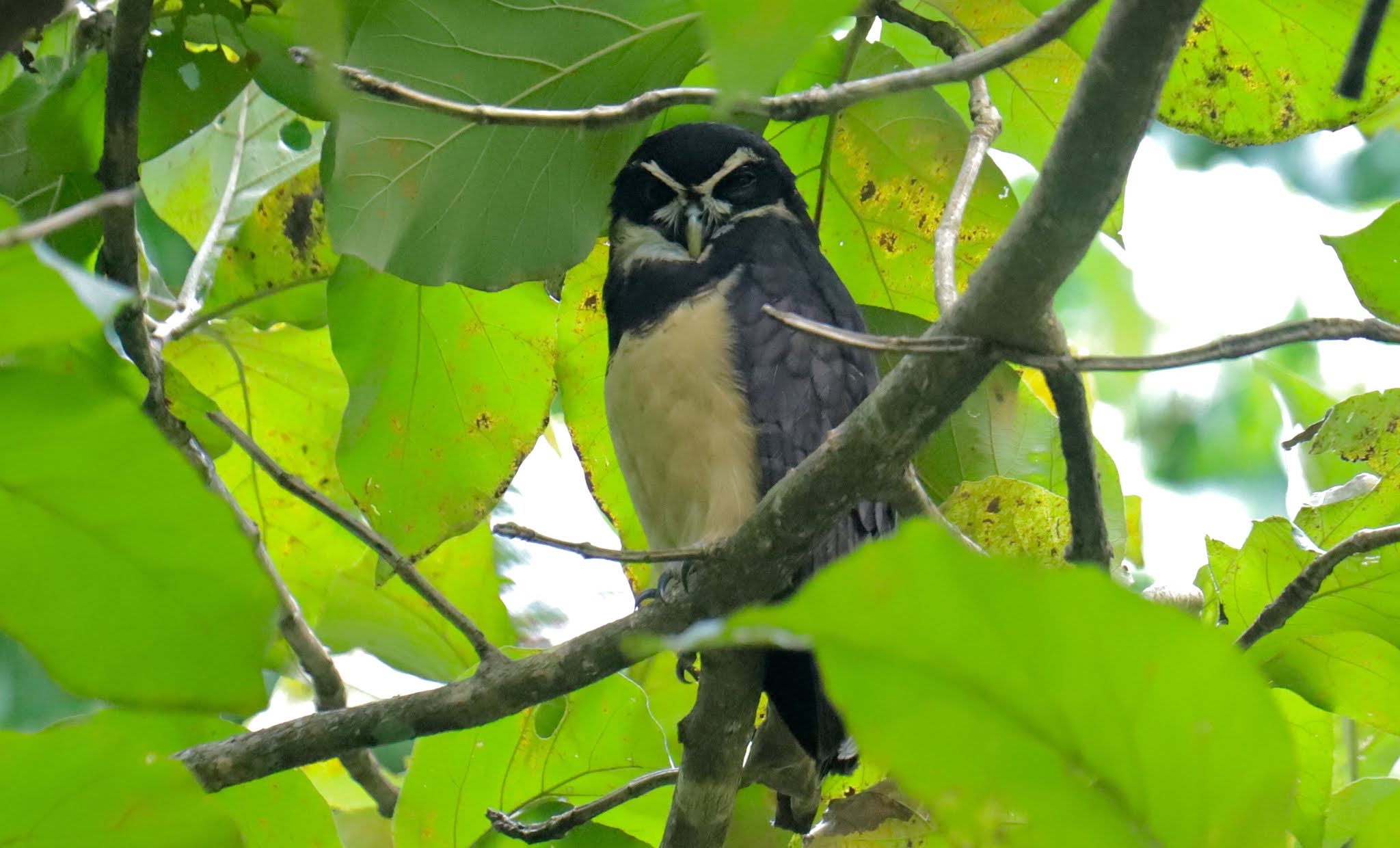
After lunch and a siesta, we headed out again and worked some gardens, fields and woodland at a housing development called Casa Iguana.  Not the most pristine of habitats but it was birding and came with the added bonus of a stakeout Spectacled Owl, a big lump of an owl and strikingly patterned.  I'd seen this species before but I never tire of seeing owls during the day so quite a treat.  The fields and empty building lots also yielded a lifer me me ... Garden Emerald ... not the most exciting of hummingbirds but hey, still a lifer.


Spectacled Owl

Tuesday, December 31 - Altos del Maria

After yesterday's great start we had great expectations for the trip 'up the mountain' to the higher elevation forests at Altos del Maria.  The region seems a popular area for wealthy Panamanians to build second houses and we birded largely from a road network that criss-crossed the forest to accommodate luxury housing on large lots.  The only thing missing were the houses, which for whatever reason had never been built, or at least had not been built yet.  Putting such thoughts aside though, we started to get to work on looking for the various specialties that could be found here, which included a half-dozen potential lifers for me.

First up was a quick stop at a known lek site for White-tipped Sicklebill, a spectacular streaky hummingbird with a remarkable bill designed for feeding on the deeply curved flowers of heliconias.  The bird was exactly where the local guides said it would be so was quickly scoped and added to the lists and we pushed on, ignoring the ominous signs on impending rain, in search of more.

Further up the road another successful forest stop yielded great looks at two shy and difficult-to-see forest birds, both of which were new for me.  The Streak-chested Antpitta sat in the open and allowed itself to be scoped, while after a little more work, a Purplish-backed Quail-Dove allowed itself to be seen peaking from the undergrowth in response to our tape.

Purplish-backed Quail-Dove

So we were on a roll and turned our attention to a new site where we thought we'd heard the enigmatic Rufous-browed Tyrannulet, a tiny bird with an odd, patchy, range stretching from Costa Rica down to Ecuador.  It was a lifer and I really wanted to see it ... and then the rain came.

I admit that I am stubborn, and so quite happy to ignore anything but the most inclement of weather, especially when I think I can hear a life bird.  I was very focussed on the tyrannulet and also on a Snowcap, another lifer, that I glimpsed briefly at the same site.  As the rain got heavier and heavier though, even the most polite and accommodating for my birding companions slowly gave up and drifted back to the van.  When the rain reached truly thundering proportions, and I was standing alone in the deluge, utterly soaked, and quite unable to hear or see much in any case, eventually even I had to give up the ghost and surrender.  There would be no more birding that day (save for some civilized squirrel-watching, beer in hand, at the lodge feeders) and I fretted about how long this seemingly endless rain would last.  We only had a few days and I'd heard or glimpsed two lifers but been denied by the weather, I could feel the chance of 5,000 slipping away.

Wednesday, January 1 - Canopy Lodge (Area)

So what would my first bird of 2020 be?  In the pre-dawn light I could hear a lot of birds, even had some idea of what some might be, but decided to wait on a bird I could actually see.  In the end, Rufous Motmot stole the prize, swooping in to the feeders in the dawn light ... and we were off for 2020!

Rufous Motmot ... my first official bird of 2020.

The next question was what would my first lifer of 2020 be?  And that was answered an hour later on the trail at Cerro Gaital where I saw and heard my first ever Spot-crowned Antvireo.   Not a bad way to start the year and in fact this trail was very birdy yielding nice views of the skulking Black-faced Antthrush, a novelty Brewster's Warbler, and even a Hoffman's Two-toed Sloth for extra measure.

Northern Schiffornis

The bird continued later in the day at Camino La Mesa - Rio Indo with a nice mix of birds including an assortment of 'ant-things' and a spectacular Brown-billed Scythebill.  Then back to the lodge for siesta and back at it for post siesta birding in another area of fields and forest edge to flesh out the list.  

Brown-billed Scythebill in the darkness of the forest


Thursday, January 2 - Bosque del Galicia / Altos del Maria

Started the day back up in the clouds in the higher elevation forest where I quickly added my life White-vented Euphonia among a lively mix of birds that included good looks at Black Guan, Northern Emerald-Toucanet, Spotted Barbtail and even a few friends from home like Blackburnian Warbler.  The highlight as we left though was a perched female Snowcap doing it's best to make up for the terrible views I'd glimpsed of the male in the rain a few days earlier.

Snowcap ... the males are flashier, but this one was cute ...

Leaving the pristine core of the forest aside we paid a visit to a landscaped mini-golf-course area nearby and were immediately rewarded with two lifers for me ... the White-tailed Emerald and the Rufous-browed Tyrannulet ... I guess if you leave the big trees and patches of the native woodland, the good birds can cling on.  

One bird I really wanted to see what the tiny Rufous-crested Coquette ... a very ornate hummingbird that was reputed to visit the flowering trees back at the lodge.  I'd already invested several hours watching those tree when I really should have been enjoying my siesta but with no luck.  Today though, the weather was on our side, and as the sun broke through the clouds and the rain held off, our local guide spotted a coquette sitting out in the open near a small lake and we all enjoyed long leisurely looks.  And I enjoyed an uninterrupted siesta.

The evening birding at Valle Chiquito was kept adding more species and actually took us to a four Motmot day ... Rufous, Lesson's, Broad-billed and Tody ... very appropriate for a tour lead by Jesse Fagan who goes by the nick-name of "motmot" in the birding world.

Collared Trogon

Friday, January 3 - Drive back to Panama City


Friday was a travel day but we took the 'scenic' route back with a number of stops in different habitats to fill out the trip list.  At one of them I got my final life bird if the trip ... Veraguan Mango ... bringing my life list to 4,997 and meaning that 5,000 would have to wait for the next trip.

We ended our birding at a delightful beach stop and picnic near Santa Clara where we added a few loafing terns and sea birds, some lovely views of the Pacific, and got to savor a great week of birding with some good food and a cold cerveza ... who knows, maybe I'll do another group trip one day ...


Sunday, August 26, 2018

Volcanoes and Pink-headed Warblers

August 2018: A Short Trip to the Volcanic Highlands of Guatemala

Tuesday, August 14 - Guatemala City to Tecpan

Some trips are just a little random.  Earlier this year, while chatting on-line with a friend (future birding star Jacob Drucker) we got to talking about Southern Mexico and from that conversation my mind drifted to some of the Central American Highland birds I really have long wanted to see.  Before too long I had arranged a short trip to Guatemala as a tag-on to my Birthday Foodie trip to Mexico City.  Why Guatemala and not Chiapas?  No good answer there really, I would like to go to Chiapas but settled on Guatemala, perhaps blaming that pesky eBird World Map that gives you such endorphins for filling in new countries in shades of yellow, orange or red.  Anyway, plans were made with Cayaya Birding and I threw the invitation open to some friends resulting in Michael Duffy, Carlos Sanchez, and Brent Bomkamp signing up to join me.

Having survived a bit of a rough landing, the Aero Mexico pilot aborted the landing twice before sticking it on the third attempt, I made it to Guatemala City and promptly passed out exhausted.  Brent ended up dropping out due to a family medical emergency but on Tuesday morning Michael, Carlos and I met with local bird expert and tour leader/fixer extraordinaire Knut Eisermann and headed off to explore the birds of the Guatemalan highlands.

First stop was a small park not far from the city center that preserved a small valley with native vegetation.  Highlight here was BUFFY-CROWNED WOOD-PARTRIDGE  a lifer for me and part of a nice selection of birds that fortified us for the long road trip to the highlands and our main birding target.  By lunch-time we'd arrived at an odd Swiss-chalet-style restaurant that specialized in crepes, but with lunch done we hiked up into the pine-oak forest behind the restaurant and were smack in the middle of our target birds.

Highlights here included BLUE-THROATED MOTMOT which we heard a lot before we finally got a good look at it.  That stunning confection of a bird, the PINK-HEADED WARBLER was also here and gave good views, and bad photos, at the top of the trail along with a supporting cast of lifers including Hooded Grosbeak, Black-capped Swallow, Guatemalan Tyrannulet and Blue-and-white Mockingbird.  A couple of hours truly well spent and a few of our key target birds locked down on the first morning made for a very good start.  And it was still only mid-afternoon on Day 1 ... what was next?

Pink-headed Warbler and Blue-throted Motmot
(Two of the star endemics of the Guatemalan Highlands)


"Next" turned out to be the Tecpan area and a site for another nemesis bird of mine, the UNSPOTTED SAW-WHET OWL.   This was a bird I've looked for twice unsuccessfully, both times in Costa Rica, and so another chance was most welcome.  The exact site had to be withheld at Knut's request and the arrival of two local guys with shotguns who escorted us into and out of the area was a definite reminder that we were off the beaten track here.  The site, more beautiful mixed forest quickly provided more lifers for me with Black-throated Jay and Rufous-collared Robin joining the life list.  As the light fell, we also had quite a night-bird treat with Mexican Whip-poor-wills, Whiskered Screech-Owls and Northern (Guatemalan) Pygmy-Owl all calling their hearts out around us and allowing themselves to be seen.  Then the Saw-Whet Owl also called and for the next hour or so we played a game of cat and mouse with it ... we would move, play the tape ... and the owl would fly over to a nearby tree and call back ... but never showed itself .... nothing more than hints of movement in the shadows.  But at least I heard it this time ... one day I will see one.

Wednesday, August 15 - Tecpan to Santiago Atitlán

After another morning in the Tecpan area we headed out towards the famous, and stupidly scenic Lake Atitlán for a two night stay.  The site of a sad extinction story where the Atitlán Grebe slipped away into oblivion as a result of human stupidity (the introduction of Large-mouth Bass for sport fishing) and a natural disaster (an earthquake that lowered the lake and eliminated feeding and breeding areas) I'd long wanted to see this place.  That a species survived here at all on such a tiny and fragile lake was a wonder in and of itself.  Still, I wish I'd been here earlier to see it, although it was gone before I started world-birding.

While our first views of the lake were scenic and high up, our first birding was at a place called IMAP where I added my life SLENDER SHEARTAIL and White-faced Ground-Sparrows.  Then a very pleasant evening ensconced at the comfortable Hotel Bambú with good food, decent wine and great views of the lake.

Slender Sheartail
Thursday, August 16 - Santiago Atitlán Area

Today I had a choice ... attempt a death march up the volcano with Knut, Michael and Carlos for Horned Guan, a bird I desperately wanted to see, or take it easier and bird some local cloud forest for a bunch of life birds.  A recent surgery made the volcano climb inadvisable and, as much as I wanted to try it, I knew I'd just slow the others down, so ended up going for the softer option.


The cloud forest option turned out to be perfectly great and I ended up adding 8 life birds with Rolando Torres on the trails at Rey Tepepul.  The adds included 3 life hummingbirds - Wine-throated Hummingbird, Green-throated Mountain-Gem and Emerald-chinned Hummingbird - plus Azure-rumped Tanager, Scaly-throated Foliage-gleaner, and Black Thrush.  The last two were the, always hard to see, White-faced Quail Dove and the long-wanted Spotted Nightingale-Thrush, a bird I've salivated over in field guides for twenty years and never connected with.  A very nice day.

Wine-throated Hummingbird and Guatemalan Tyrannulet

After my birding morning, I ordered a nice lunch and a margarita, took a nap and was reading by the pool when I heard the sound of sobbing and shuffling on the path to the room.  Michael and Carlos had triumphed and seen the Horned Guan but at great physical cost it would seem as they limped back to the hotel in search of a hot tub or alcohol or both.  Physically I clearly made the right choice ... but maybe there are some Horned Guans closer to the road somewhere?

Friday, August 17 and Saturday, August 18 - Los Tarrales

A quick stop for the last major target bird of the trip, the BELTED FLYCATCHER, which despite Knut's pessimistic expectation management showed itself easily at Finca Santa Victoria.

Rusty Sparrow
Then the long drive to Los Tarrales was made longer by a defective van that couldn't break without an ominous wobbling and shuddering sensation and so the driver stayed stubbornly in second gear the whole way.  Once we arrived though, and sent the driver back to get a replacement van, we settled in to great food, nice rooms, and an afternoon/evening that alternated between birding around the lodge and drinking wine and reading bird books in the library.  Sure the rain was torrential but the settings were scenic and we still managed to whittle out some good life birds (White-breasted Chachalaca and Yellow-naped Parrot) and the lodge itself with it's faded affluence, bird art collection and welcoming staff made for a very pleasant experience.

The rain, mercifully had stopped in time for our last morning of birding where a Mottled Owl called to us as we climbed into a four-wheel-drive vehicle for the climb up to the higher altitude forests on the preserve.  I tried scoping the cloud forest for a Horned Guan (technically possible I suppose) but most of the day was spent slowly descending through the forest and we did encounter a good mix of species.  Highlights for me were lifer Blue-tailed Hummingbird, Ruddy Woodcreeper, and a BLUE SEEDEATER, a bird I really had not expected to see.  Carlos and Michael also got to catch up on some of the species I'd seen two days before and in total we rounded off a very nice list for a short trip.

Food was overshadowed by the Mexico trip but here a traditional Mayan
Fish Stew
Then back to Guatemala City, a delayed flight and a bouncy red-eye back to New York.  Overall a very nice trip and I definitely left wishing I had another week this time.  I think I'll be back, and not just for that pesky Honed Guan.