Showing posts with label Shorebirds. Show all posts

Monday, September 25, 2017

Rock Partridges, Rock Nuthatches and Ancient (stone) Temples

A Weekend Birding in Greece

So what to do when you find yourself with a free weekend on a business trip to Europe?  Not the most productive continent for potential life birds for me but it gave me a chance to go somewhere interesting, and if I could add a few life birds while I was there, so much the better.  After considering several possible countries - Spain? Portugal? Tunisia? - I settled on Greece, and flew down to Athens for two days of birding with Lefteris Stavrakas a local hot-shot birder who'd arranged a quick hit trip for me focussing on a handful of possible life birds.

Friday, September 22 - Sounio, Messolonghi and Kleisoura Gorge

We started the trip at dawn on day one birding near the Temple of Poseidon on rocky slope overlooking the Agean Sea .... how perfect a start to a Greek birding trip was that?  Our target here wasn't very exciting, but we soon managed to find a family group of Chukars (Life bird number 4,030) and duly added it to my life list.  Chukar is a widely introduced game bird (for shooting) and can be found across Europe and the American West ... I'd just never managed to bump into one.  These Chukars were introduced too, but common and established breeders (they occur in their native range on the near-by Greek islands and were introduced to the mainland when the native Rock Partridges got scarce due to hunting pressure) but I had to count one for the list at some point so I chose to take these for my life birds.  I felt a little dirty, but got over it and moved on fairly quickly, after all, I'll never have to life list Chukar again..

Next stop, after a longish drive, was the lagoon complex at Messolonghi which was simply stuffed with birds.  Shorebird migration was in full swing and we saw 22 species of shorebirds, including Broad-billed Sandpiper, and a wide range of waterbirds of various sorts.  My target bird here was Dalmatian Pelican (4,031) and we quickly saw four of these giant waterbirds along with a lot of ducks, terns, gulls, flamingos and a good scattering of migrant passerines.  A very birdy spot indeed.

Dalmatian Pelican (above) and Greater Flamingo

I also got my third life bird of the trip here when we tracked down some Western Rock Nuthatches (4,032) near the fascinating mud nest they'd presumably used this year.  This species was common and very vocal here, indeed we saw or heard a lot over the weekend, but seeing them around their amazing mud nest was a great way to add a species.  A very cool bird.

Western Rock Nuthatch and Western Rock Nuthatch nest

Black-Eared Wheatear
Last stop of the day was a stake-out (I haven't been doing well at stake-outs recently) where a Cinereous Vulture had been roosting with some Eurasian Griffons (Vultures) on the cliffs at a gorge.  We gave the bird a lot of time, enjoyed great views of the Griffons, increasingly rare given the global vulture collapse, and saw a good range of other raptors.  Our target bird however, did not show up, maintaining a tradition of me not seeing this species in places (Spain, China, etc.) where I could have done so. Ho hum ....


Saturday, September 23 - Nafpaktos, Kopaida, Athens

After spending the night in the grandly named, but rather basic, Hotel Aphrodite in Nafpaktos (not that I cared, I could have slept anywhere at that point I was so tired), we got up early and headed East along the coast road hoping for two more of my target birds.  We stopped at a small village and started birding the rocky cliffs and olive groves around it hoping for one target but quickly lucked out with another one when a very vocal Sombre Tit (4,033) popped up in an olive tree.

Bad record shot of a Sombre Tit
Pushing uphill we played recordings of what we though might be the most challenging target bird of the trip - scarce, heavily hunted and therefore very shy - and were rewarded (and a bit shocked) not long after when a Rock Partridge (4,034) called back.   Now all we had to do was see the bird .... somewhere up on a vast rocky slope above us.  In the end, persistence paid off and I caught a glimpse of movement well up the hill-side and was able to train the scope on a clearing in time to see a family group of partridges scuttle through it.  I was thrilled at the sighting, but mostly relieved that I didn't have to climb that slope to look for the birds.  Definitely the highlight of the weekend for me.

Can you see the Rock Partridge in this photo?
The Rock Partridges turned out to be the last lifer of the trip.  We spent a lot of time at the Plain of Kopaida looking for, and not seeing Long-legged Buzzard (although we saw a lot of other birds) and hit some coastal and woodland spots in search of year birds for me.  In all we saw 112 species, 5 life birds and 76 year birds, not bad for a weekend.

Red-footed Falcon at the Plain of Kopaida
By the time I got the Athens airport I was exhausted.  Two full days of birding on not a lot of sleep and a long flight back to New York ahead of me.  I guess I'm not as young as I used to be, but was it worth it?  Yep, it certainly was ....


Monday, June 12, 2017

Birding the Beaches ....

Small Scraps of Birding Time on Long Island in June

Saturday, June 3 - Brooklyn and Queens Counties

The day actually didn't start in Brooklyn or Queens, but rather in Somerset County, New Jersey where I chased, and disastrously dipped a LESSER NIGHTHAWK.  I don't often leave New York State when I'm birding locally but if I do it's usually because a bird catches my interest and sticks in my mind.  This bird did just that, originally identified as a Common Nighthawk and posted on-line, then re-identified as (New Jersey's Second ever record of) a Lesser Nighthawk by Ben Barkley, the bird was subsequently found to have been picked-up and re-habbed locally a few days earlier, before being released nearby.  Once free though, it settled into a nice pattern of sitting on a rail fence or along a gravel path at Lord Sterling Park allowing lots and lots of local birders to see and photograph it during its week long stay.  I got there early on Saturday after a rough drive where the Land Rover's navigation system was totally overwhelmed by the road-spaghetti that is Northern New Jersey, sending me the wrong way several times and even directing down a one-way street the wrong way at one point.  Oh and it was raining when I got there, and oh, the bird seemed to have departed during the night never to be seen again.  Not a good start to the day.

Nelson's Sparrow
So back to New York where my first stop, Plumb Beach in Brooklyn, improved my day immeasurably.  There had been reports of a very unseasonal NELSON'S SPARROW singing in the marsh here (not unusual in the Fall, but rare in the Spring) and as soon as I hiked out to the East end of the beach I could hear it singing loudly and see it sitting up in plain view.  This tiny marsh also had Seaside Sparrow and Clapper Rail (both King's County birds for me) so I felt that returning to New York was clearly the right strategy and pushed on to Jamaica Bay in Queens.

As I pulled into the reserve parking lot I picked up and email saying that Tim Healy had just had a Least Bittern at Big John's Pond, so off I went, hoping for the Bittern and perhaps a glimpse of the resident Barn Owls ... I saw neither.  Back to the West Pond where my spirits picked up when two year birds - a Gull-billed Tern and a Tricolored Heron flew into view within minutes of each other.  Back to being in a good mood and, after checking some other local coastal spots, I called it a day.

Tricolored Heron
Sunday, June 4 - New York County

The long anticipated Pelagic Trip out to the Hudson Canyon was cancelled due to weather.  No South Polar Skua for my New York list this year.

Saturday, June 10 - Suffolk County

Cupsogue again at dawn and I opted to take the shorter, calf-deep stinky mud route out to the flats .... just as gross as I remembered it.  The morning did produce a nice clutch of year birds though with Black Tern, Royal Tern, and Seaside Sparrow all joining the year list.

I also checked Mecox Inlet twice that day, hoping for a recently seen Black-necked Stilt.  While that bird was a no show, I did see four Lesser Black-backed Gulls, more Royal Terns and a nice mix of terns and shorebirds.

Common Tern, one of 7 species of terns seen over the weekend and the only
one close enough for a decent photo ...
Sunday, June 11 - Suffolk County

Back at Cupsogue again for the early tide but this time a quick sea-watch proved productive with four Wilson's Storm-Petrels close to shore (I know, Brian Patterson had a Swinhoe's Storm-Petrel in North Carolina this weekend, but I was still happy to see any Storm-Petrel given that our boat trip got cancelled).  The flats were also lively with more Royal Terns, Roseate Terns and some nice scope views of an adult Arctic Tern.  When I first moved to New York, Arctic Terns were almost never reported from the state other than on pelagic trips; now they are seen annually at various tern loafing spots along Long Island.  This doesn't seem to be a case of a change of distribution as much as a case of more observers being better at picking them up - better birders, better optics.  This bird was of course the reason I went to Cupsogue three times, so I was glad to finally get one.  Now the focus shifts to finding a Sandwich Tern!

Great and Snowy Egrets at Three-Mile Harbor in East Hampton
In addition to Cupsogue, I also hit Mecox a few more times and checked out a bunch of the local sites like Three-Mile Harbor, etc.  Nothing amazing there - a Saltmarsh Sparrow was the best bird at Sammy's Beach - but a nice local mix of breeding birds.  A very nice weekend of local birding.

Thursday, June 15 - Nassau County

There had been two Black-necked Stilts at Jones Beach for the previous two weeks ... a bit of a rarity in New York and a county bird (and state year bird) for me.  I was there at 6:00am, just in time to see a helicopter spray the area for mosquitos and flush every bird for miles around, and again at 3:00pm.  Not a stilt to be seen ....  hopefully not slipping back into a dipping phase ....

Saturday, June 17 - Western New York State

And while I was out of town, a BROWN BOOBY was found at Nickerson Beach in Nassau County .... argh!  This species is now a good candidate for my official New York State nemesis bird given the number of times I've missed it in the state (it's either this species or Mew Gull).  I was 450 miles to the West when it was found and briefly considered driving back overnight to be there at dawn to see it.  In the end I was just too tired to do that safely so gave up, and was glad I did as the bird was found dead the next morning.  To drive eight hours to see a dead Booby would not have been a fun thing.....

The reason I was out of town was a good thing though.  One of my goals this year was to have a life list in each of New York's 62 counties.  I was close to this goal, but given a quiet, free weekend, decided to finish it off with a 1,000 mile drive through the West of New York State, filling in the last of the counties.  The birds weren't very exciting, but the birding was pleasant and I got to see some new places and bird some new habitats.  A nice outdoorsy, if very introverted, weekend ... sometimes us introverts need quiet time.

All done.  Now I just have to keep adding to the lists.
Saturday, June 24 - Suffolk County (The Hamptons)

Started the day with a sea-watch from Amagansett and royally messed up.  I had a lot of stuff to schlepp out to the house on Friday so I opted to leave my camera behind .... NEVER leave your camera behind!  As soon as I walked on to the beach I saw two birds that I would really have liked to photograph ... big, dark skua/jaeger types of the sort that could have been big, dark, (rare) Pomarine Jaegers or (much rarer) South Polar Skuas.  In sea-watching you don't get a lot of time as birds hurtle past so, if I'd had my camera, I could have taken a few shots to study later at leisure and work on the ID.  So in the end I had to report these birds as Skua/Jaeger sp. a real lost opportunity.

The day did get better though when I had some friends from the city, some local fishing friends and some of the local hotshot young Long Island birders over for dinner.  Cooked Paella and made Olive Oil Cake ... yes, I can cook ... a very pleasant evening.

My Paella - my giant Paella Pan is one of my prize possessions ....
Sunday, June 25 - (local) East Hampton Spots

Hit a half dozen local spots.  Saw nothing remarkable, but felt good about putting in some local coverage time.

Overall a good June.  Saw a lot of birds, none terribly rare, but I did feel like I spent time with New York's breeding birds for the first time in a few years.  And so on to more adventures in July ....


Monday, May 22, 2017

A Mad Scramble to 'Do' Spring Migration in New York

Three Weeks of Migration Madness

Back from three weeks in Asia at the start of May and checked in to see what I'd missed in New York.  Turns out that migration was well underway and in fact I'd missed a good early push, so much so that when I checked where I was on the "Hot 100" for the year in New York State on eBird ... I wasn't even in the top 100.  So some catching up to do ....

Black-billed Cuckoo
So into a routine.  Up at 5am, neglecting the gym (it's not pretty) and spending a couple of hours in Central Park each morning before work, then occasionally hitting the park, or another, after work for an hour to chase a specific bird.  The weekends I jumped in the car and ran around in the counties just outside the city to add more birds.  Over the course of the first three weeks of May I added 93 species to the year list, all basically in or around New York City (and yes, as of today I'm back in the Top 10 of the "Hot 100" which means I'm basically back in with the pack.

Kentucky Warbler (Photo: Anders Peltomaa, used with permission)
Most of the month was actually pretty flat, with Northerly winds slowing migration to a dribble, but there were a few epic days that even the old-timers had to agree were amazing.  I saw nothing particularly rare, and am in fact missing several species that I could have seen had I been here for the whole migration, but there were some memorable moments.  A Kentucky Warbler in Washington Square Park briefly became a local celebrity with the local drug dealers (just selling loose joints, nothing dramatic) asking us if we were looking for the 'Little Kentucky Bird".  Several Bicknell's Thrushes were reported, and I even chased one but didn't see it (I've never seen one away from breeding territories), although I did have a nice consolation views of singing Gray-cheeked Thrush.  I also had several Summer Tanagers, a Blue Grosbeak, a couple of Olive-sided Flycatchers and 31 species of North American Wood Warbler (which means I'm still missing 3 or 4 possibles).

White-tailed Deer and Cerulean Warbler 

The Power Line Cut at Sterling State Forest - the most reliable site for Golden-winged Warblers in the Southern
part of New York State.
Among the day trips.  A very wet swing through Albany, Schoharie and Otsego Counties in a rain storm provided American and Least Bitterns, Virginia Rail and other marsh birds.  A trip to Rockland and Orange Counties yielded Golden-winged, Cerulean and Mourning Warblers (plus a second Kentucky Warbler) and Acadian Flycatcher.  Ulster County chipped in grass birds like Bobolink and Grasshopper Sparrow while Suffolk County gave me Vesper Sparrow.  Queens County gave me Little Blue Heron and some shorebirds, and I was even able to pick up some county birds like my first Purple Sandpipers for New York County.  The tapestry of a Spring Migration year list slowly coming together.

Shawangunk Ridge in the background at Shawangunk Grasslands
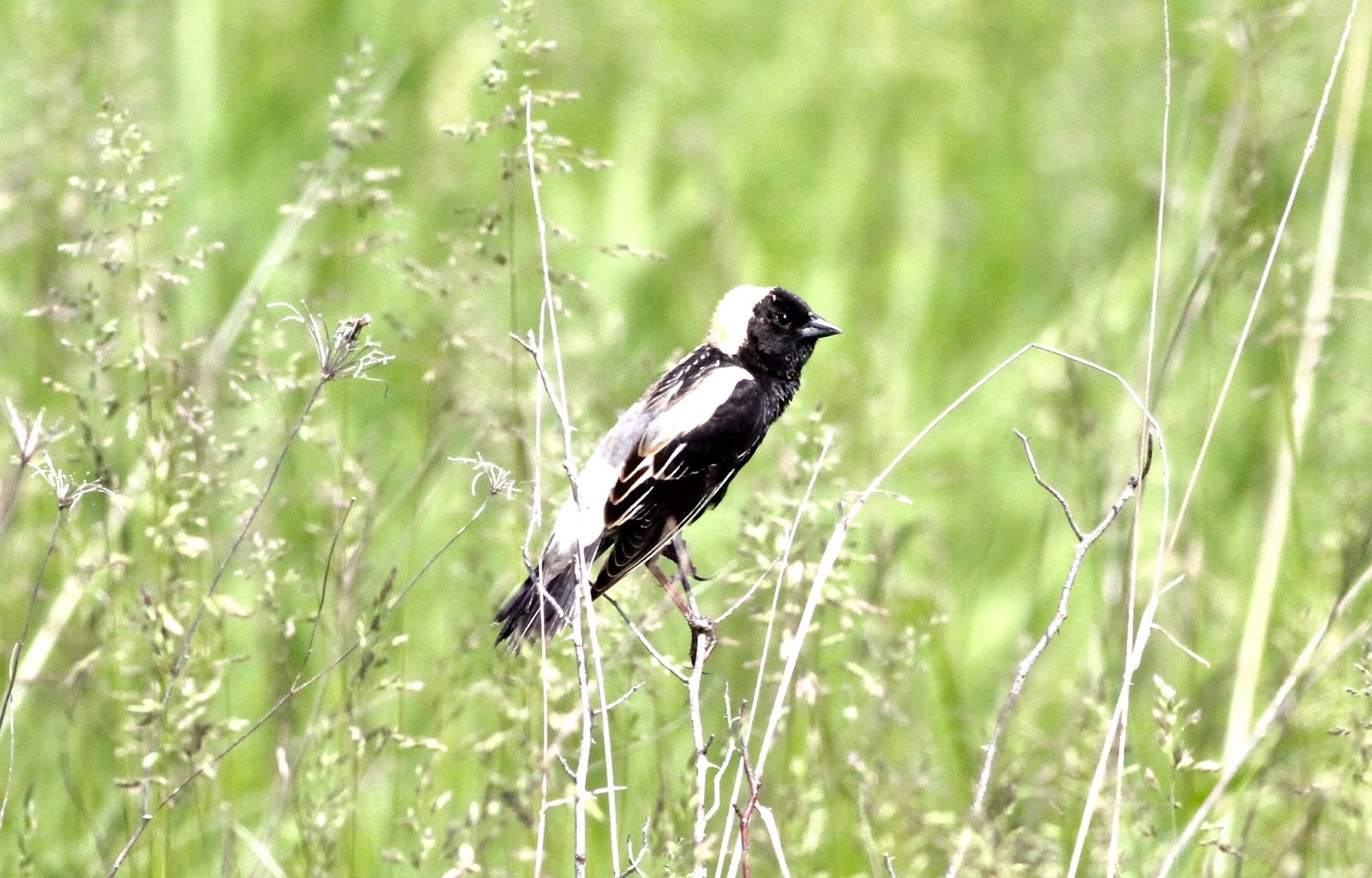
Bobolink and Grasshopper Sparrow


So after the craziness, back to a more stable routine.  This morning I got up at 5am and went to the gym, ignoring reports of Bicknell's Thrushes (which I never see anyway).  Feeling like I'm pretty much caught up now so I can focus on rarities and travel and don't need to be running around quite so much.

And as of today - New York State Year List 2017 = 257 / Rank 9
World Year List 2017 = 917 / Rank 27

Postscript:  within days of my writing this, and stopping the mid-week birding and going back to work (and the gym) both a Swanson's Warbler and a Henslow's Sparrow showed up in or close to the City.  I've seen both before in New York but both are VERY good birds here and I wasn't able to go and see either.  Oh, and several Bicknell's Thrushes showed up too .... you can't see everything ....


Sunday, October 2, 2016

The Dipping Curse Continues ....

A good weekend on Long Island and Another Dip in the West of New York

Saturday, September 24th - Long Island

Birding today with Corey Finger and Carlos Sanchez who was visiting from Florida.  Started out at Jamaica Bay, and while things started slow, it ended up being a pretty solid day.

Started late and caught up with Carlos and Corey a fair way up the East Pond.  They hadn't seen much of note and were generally belly-aching about the lack of decent birds.  There were a group of CASPIAN TERNS on the Pond (a bird I'd only added to my Queens list a few weeks before) but not much in the way of good shorebirds.

Caspian Tern
Turning around though, we started to add a few good birds on the way back South, including a couple of close STILT SANDPIPERS, and few WESTERN SANDPIPERS and then a really interesting BARID'S SANDPIPER.  This last bird was an ABA bird for Carlos (he'd seen them before only in Ecuador) so his mood was transformed.  The bird also seemed to be injured and only has one eye, making us wonder how it was going to make it down to Argentina.  Out concerns were well founded it turns out as we heard later that the bird was caught at eaten by a pair of hunting Peregrines not long after we left.

Stilt Sandpiper (above) / Western Sandpiper (below)

The unfortunate, one-eyed, Baird's Sandpiper during the last couple of
hours of it's life.
After Jamaica Bay, we hit Jones Beach then rushed out to Riverhead, hoping to catch up on all the grassland shorebirds that had been seen regularly the week or so before.  Unfortunately, they all seemed to have left the area for points South so we gave in, parted ways and Carlos and I headed out to East Hampton to join friends if mine for an amazing dinner in Sag Harbor (who doesn't like Portuguese Seafood Stew?).

Highlight of my weekend ...
Sunday, September 25th - Suffolk County

A very pleasant morning birding some of the hotspots in The Hamptons.  Late Least Terns, lots of Royal Terns, Saltmarsh Sparrow, and Clapper Rails all made for a good morning.  Bird of the day however was a migrant SORA, Suffolk County Bird number 315 for me (and day you get a County Bird in your home county is a good day!).  Then back to the City to pack Carlos off to warmer climes for the Winter.

Friday, September 30th - Cayuga / Tomkins Counties

While we were on Long Island, as inevitably happens, a good bird was found (or in this case re-found) upstate.  A BROWN BOOBY was pinned down on Cayuga Lake and, anyone who knows me knows that this species if fast becoming my New York State Bogey/Nemesis Bird.  So, with a quiet calendar, and daily sightings of the bird, I took a day off on Friday and drove 5 hours to Cayuga Lake to try to get it.  I was so confident of getting this bird - which had been sitting on a particular favorite buoy ever day - that I made plans to do some county birding on the way back, hoping to fill in some white spaces on my eBird profile.  Needless to say though, that twitches to Upstate New York are not really my fiends and, after spending the whole day scanning buoys on the lake, I dipped and had another 5 hour drive to savor my failure and shame.

p.s. the bird was of course seen the next day at a new location further down the lake and has been seen sporadically since.  Of course ....


Friday, September 9, 2016

Last Gasp for Shorebirds and a Hurricane Of Sorts

A Big Weekend Year-Birding Blitz on Long Island

Well after a spectacular pelagic trip, and three State Birds (plus 8 year birds) I turned my attention back to New York State year birding.  I'd set a goal this year of 300 species in the state (after the pelagic I was at 290) and staying in the Top 10 of the "Hot 100" top eBirders for the state this year (before the Pelagic, I'd dropped to 10th.  Two things quickly sunk in:

1. It's going to take a lot more than 300 species to stay in the Top 10 this year, lots of people seem to be birding hard so I'm guessing 310 or 315 will be required.
2.  I'd almost completely missed shorebird season (and most of tern season) so had missed a dozen relatively easy birds to add to my list.

Friday, September 2 - Jamaica Bay

So how to salvage some birds.  Step one, off to Jamaica Bay on Friday morning for a mid-morning tide and hopefully some catch-up shorebirds.

Heading into the East Pond (with my super cool French knee-high mud-boots and lots of sun-block and bug spray liberally applied - I felt very prepared) it was quickly obvious that it wasn't going to be an amazing shorebird day.  There were lots of Semipalmated and Least Sandpipers, quite a few Short-billed Dowitchers, and a scattering of Oystercatchers, both Yellowlegs and a few Semipalmated Plovers ... but not much of the good stuff.

Short-billed Dowitcher and Lesser Yellowlegs

But patience is a virtue, so over the next three hours I slowly worked North along the East side of the East Pond and scoped every single shorebird I could find.  And that kind of thorough scope work, does produce, adding a single WESTERN SANDPIPER (291), two WHITE-RUMPED SANDPIPERS (292), a PECTORAL SANDPIPER (293) and a solitary juvenile STILT SANDPIPER (294).  I was hoping to come up with a Baird's Sandpiper too but one one eluded me, still four year birds was worth the long walk in the mud.

White-Rumped Sandpiper - not the spiffiest shorebird
Apart for the shorebirds, there was the usually selection of gulls, ducks, etc.  plus a very aggressive Peregrine Falcon that delighted in torturing the shorebirds at regular intervals.  Birds of the day though were probably two CASPIAN TERNS which were my first ever at Jamaica Bay and my first for Queens County (#235).  Always good to add a county bird.

So six more species to go ....

Saturday, September 3 - Riverhead "Sod Farms" Suffolk County

With the dogs in the car, and plans in East Hampton, the idea of birding on the way out East on Saturday was a bit impractical, but having made good time on the drive out, I figured I could grab a half hour to see if I could get some of the recently reported "grasspipers".  For this to work though, it had to be a 'surgical strike' so I ran up Doctor's Path and crossed Sound Avenue, as much hoping for birders with scopes as actual birds (I really didn't have time to do thorough scans).

Today my luck was in, I bumped into a group of birders who'd found a flock of birds including many Killdeer, Semipalmated Plovers, a BUFF-BREASTED SANDPIPER (295) and two BAIRD'S SANDPIPERS (296).  This group also had heard rumors of plovers over near Osborne Avenue so, not three minutes after jumping out to scope their birds, I was on my way again looking for my third target.  As it happens, I didn't quite make it to Osborne Avenue, as just before I got there, I passed a field full of 50+ AMERICAN GOLDEN-PLOVERS (297) ... and I was on my way again in under 25 minutes.  Efficient listing ....

American Golden-Plovers just hanging out next to the road
Now, I was on a roll so, after I dropped the dogs off at the house, I decided to see if I could find a lingering Roseate Tern at the Fish Traps (a spot where terns hang out) at Sammy's Beach near the house.  There was in fact a ROSEATE TERN (298) there along with 50 Common Terns and a surprise of two ROYAL TERNS (299) a bird I've never seen at Sammy's Beach before.  And at 299 I obviously wanted to end the day at 300 species to checked a few more local spots before setting up for a nighthawk vigil (someone I've done many nights so far this year without luck) and was rewarded this time with a COMMON NIGHTHAWK (300) at dusk.  Perfect birding day.

Monday, September 5 - Amagansett Beach, Suffolk County

The weekend forecast has been wind and rain, but Hurricane Hermine was staying well offshore and not really producing the kind of weather that leads one to expect storm-driven seabirds.  Still, it's always worth sea-watching so I slogged down to Amagansett on Monday morning and put in a three hour sea-watch over messy, swirling surf in decent, but hardly storm-force, winds.


It was obvious pretty quickly thought that something was up.  Being the swirl of gulls offshore there were tubenoses moving, but most were too distant and to too briefly seen to identify to species.  Over the course of the watch though I did pick up a couple of Cory's Shearwaters, 2 Sooty Shearwaters (301) and a single Manx Shearwater (302) plus some gannets, and a Parasitic Jaeger (303).  All good sea-watch birds Out East, but soon quickly eclipsed by a bird that I immediately 'felt' was a pterodroma based of flight style.  The bird arched and power glided effortlessly across the waves, making the shearwaters look sloppy and sluggish by comparison - brown uppers, dark heard, and a big white rump could mean only one of two things and as the other one was too super-rare to really consider seriously, I went with BLACK-CAPPED PETREL (303), a very, very good bird from land in New York.

Turns out that others were having a good day too, and others also had shearwaters and Black-capped Petrels.  Ironically, the weather didn't really suggest a great sea-watch day, and birders closer to the city struck out.  Right time, right place I guess ... until I heard about the booby!

Turns out that Nadir Souirgi, who was just a few miles to the West of me, had an adult BROWN BOOBY pass him, heading East.  That would have been a state bird for me, and a very much wanted one ... but alas I never did pick it up and missed out on what was probably the best bird of the day.  Can't win them all I guess ....

Saturday, June 25, 2016

Back to New York

From 3-Michelin-Star Restaurants in Paris to the Muck of Jamaica Bay

Saturday, June 25 - Jamaica Bay

Flew back from Paris this week and started getting back into New York mode.  I hadn't missed a lot of birds but there were a few year birds on offer down at Jamaica Bay.  Decided to do a leisurely morning visit and wandered down to the preserve by about 8:45am.  The main target was a White-faced Ibis, a bird that had been found two weeks ago and seen on and off since then, but not for a few days.

Settling in at a nice shady patch in the phragmites at the South end of the East Pond I decided to just wait it out and see what came along.  There were a few Ibis around but all seemed to be Glossy Ibis.  I could tell though that there was turnover, with a Ibis or two leaving every 10 minutes or so, and a few new ones dropping in for a freshwater drink after feeding in the salt marsh.

Yellow-crowned Night-Heron
There were a couple of other year birds I was hoping for too, and they actually popped up pretty quickly,  A trio of Black Skimmers (280) swept past not long after I arrived, and some diligent scanning produced a single Gull-billed Tern (281).

Black Skimmer and Gull-billed Tern seen later from the "Raunt"
I was here fro Ibis though so every 5 minutes or so, I scanned the little group of Ibis on the far bank to see if the target bird had dropped in.  There were never more than 6-8 Ibis present, but while I was there perhaps 25-30 individual birds made brief appearances before heading off to feed again in Jamaica Bay.  After about 45 minutes, and scan 9 or 10, a White-faced Ibis (282) magically appeared in the little group.  Very nice ...

Crappy record shot - digiscoped at 70x on the scope (and extra zoom from the iPhone)
And so on to Big John's Pond, which had an intriguing bird I was curious to see (or more realistically hear).  The Blind (hide) at the pond was predictably full of photographers taking thousands of shots of the resident breeding Barn Owls, but I birded the area for a bit listening for quite a different species.

Barn Owls in Boxes ... pretty much how I see all my Barn Owls these days ...
The U.S. has good turtles ... Eastern Painted Turtle ....
The 'Other' Night-Heron .... Black-crowned ....
Standing quietly on the trail I could hear at last two Willow Flycatchers ("Fitz-Bew") and then, after drifting South a bit, I heard a distinct Acadian Flycatcher ("Pee-Zah").  A new bird for Queens County New York for me (Number 233).  It had been previously reported, an odd location for the species, but not entirely unsuitable habitat.  Good bird.

So after checking the West Pond, and toying briefly with the idea of going back to the East Pond, I headed back to the City.  When I got out of my car, I checked emails and saw that Ken and Suzy Feustel had just reported a Ruff from the East Pond.  Hmmmm ... I'd had such a good morning, seen all my target birds, I guess I should have expected a karmic rebound like this.  Still, there's always tomorrow .....

Sunday, June 26 - Jamaica Bay

Got to the East Pond at around 7:30am, and on the way got updates that Corey Finger had already seen the Ruff (yay!) but that he couldn't relocate it a little later (Boo!).  Spent the next four hours with many other birders carefully scanning the East Pond but alas, at least as of when I had to leave, no Ruff.

"So are you doing a big year?" someone asked while I was there.  "Never again" I replied.  It does seem that some have speculated through.  So let me give some context ....

By the end of June in 2012 my New York State year list was 322 Species.  Ironically, Ruff was that 322nd species, seen at Montezuma NWR on June 25th.  That's 40 species ahead of where I am this year.   Even if I did want to do a big state year, which I don't, I'm way behind the pace and have missed way too many rare, and not so rate birds already.  You can't just bird hard (which I am) in New York and build a big year total, Big Years are a completely different game requiring lots of chasing and few misses.

I do have a New York State goal for this year though, which was to see 300+ species and stay in the Top 10 of the NYS "Hot 100" on eBird.  Just something to motivate me, and so far I seem to be on track ... but another New York Big Year?  Hell no!

Just setting the record straight ....


Sunday, May 15, 2016

After the Wave - Filling Out the List

Peak Migration around New York City - Week 3

Tuesday, May 10 - Central Park

Sunday did in fact turn out to be the 'day of the year' in Central Park (and many other City Parks) with over 120 species of bird, and 28 species of Warbler reported in Manhattan's "Green Lung".   Monday was also very good, with many of the same birds remaining, but unfortunately I had to work that day.

Tuesday morning was beautiful, perfect weather setting off the amazing fresh green leaves of late Spring.  There were quite a lot of birds around too and I saw about 50 species, including 14 species of warbler in an hour-and-a-half on the way to the office.  I also added two year birds, ironically within seconds of each other, with a Solitary Sandpiper (242) flying by Bow Bridge and a Blackpoll Warbler (243) in a  tree overhead.  I also looked hard for the Summer Tanager, Bay-breasted Warbler, and Black-billed Cuckoo that I'd missed over the weekend but no luck there.  Plus I realized that I was still missing Orchard Oriole for the year ... fast becoming my Spring nemesis bird this year.
Not the ugliest place in the world to bird ....
Thursday, May 12 - Central Park

Another gloriously beautiful day and a few more birds.  Bumped into a lot of birders in the Park that morning (including old friend and global conservation hero Nigel Collar of Birdlife International) and all agreed that it was really quiet.  I felt it was really quiet too, but at the end of the brief morning walk-through I'd seen 16 species of warbler, although mostly just 'onesies and twosies' with no particularly rare species.  Best bird of the day came as I walked into the Park and heard a distinct "Where -We" call from dense cover near the Upper Lobe.  No question what it was but I wanted to at least lay eyes on this Empidonax flycatcher for additional confirmation, and managed to get a brief look at this Alder Flycatcher (244) before losing the bird as it moved North.

Not long thereafter I saw a tweet about a Bobolink near the Delactorte Theater.  I was close so wandered over, heard the bird, and joined a small group of birders nearby who I assumed were watching it.
"Sorry, it flew North" they said.
"Nope ... it's right here, figured you were watching it" I replied.  And we all quickly repositioned and at least hear the Bobolink (245), the R2D2 of birds, singing high in a tree for a while.  Good morning.

But still no Orchard Oriole ....

Saturday, May 14 - Rockland / Orange Counties

Time for a break from Central Park so I picked up Michael Duffy at 6:30am and headed North to Doodletown Road in Rockland County.  There we met up with Tom Socci and spent a couple of hours working one of my very favorite birding spots in New York.

Doodletown is an old settlement that has since been abandoned and left to the woods to reclaim.  The remains of the roads are still there though, affording relatively easy, and tick-free (important in New York) trails into great habitat.  It's famous for it's warblers but all sorts of good mid-atlantic species breed here, and of course there were lots of birders there today too.

The habitat at Doodletown Road and a Cerulean Warbler at the top of a tree 

We started climbing the trail as soon as we got there and struggled to penetrate the wall of bird song that overwhelmed us.  Soon enough though we heard the distinctive buzzy song of Cerulean Warbler (246) and blocked out the rest of the chatter to focus on these star birds.  While we were watching then we also got a glimpse of the nemesis Orchard Oriole (247) but I was so focused on trying (and failing) to get decent Cerulean shots that I pretty much ignored it.  Further up the trail we had plenty of cuckoos, with at least five Yellow-billed Cuckoos and a single Black-billed Cuckoo (248).  I also heard an Acadian Flycatcher (249) but, with over 20 species of warbler in the bag, we then mostly focussed on getting Doodeltown's most desired warbler species.   We had good intel and headed to the spot where it had been heard singing the week before.  As we got closer, returning birders confirmed we were on the right trail and then, just before we got to the site, we heard a Kentucky Warbler (250) singing.  A few tense minutes of listening later, the bird broke cover and, quite uncharacteristically for this usually skulking species, sang loudly from trees right over our heads for five minutes.  Great bird.

Kentucky Warbler - Photo: Tom Socci (used with permission)
After a quick, and unsuccessful, look for Timber Rattlesnakes - we'd bumped into superb all-round naturalist Rick Cech who gave us directions, but no luck - we decided to rush over to Sterling State Forest in Orange County while the birds were still singing.

Scarlet Tanager
Sterling is another great spot, although I always have mixed emotions when I come here.  It's the last stronghold of Golden-winged Warblers in Southern New York but they are slowly being replaced/overwhelmed by Blue-winged Warblers and no-one is sure how much longer they can hold out.  Sure enough, it didn't take us long to find a pair of Golden-winged Warblers (251) and got to watch the familiar pattern of the male Golden-winged trying to keep a male Blue-winged sway from his female.  Make Golden-winged Warblers spend a large chunk of their day doing this and it has to impact breeding success.  Every year there are more hybrids and few Golden-winged Warblers in New York.  It's quite sad to watch in real time.

Prairie Warbler
Two different Golden-winged Warblers 

Indigo Bunting ... always a crowd-pleaser
At Sterling we also had an unexpected bonus bird.  A Broad-winged Hawk (252) flew low over the woods and must have crossed close to a Barred Owl (253) nest, unleashing a storm of complaints from the owls.  Always good to get an owl in the day ...

Sunday, May 15 - Nassau and Queens Counties

I made a tactical mistake today and headed to the coast rather than going to Central Park.  Of course, all day the Manhattan Twitter Bird Alert buzzed with sitings of rare birds and now potentially missed year birds for me.  Bay-breasted Warbler, Mourning Warbler, Olive-sided Flycatcher, Philadelphia Vireo, and even a Common Nighthawk.  Oh well, can't get them all ...

I did have a great few hours at Jones Beach though, added a few year birds and got to see a nice smattering of migrants on what turned out to be a cold and windy day.  That at least kept Jones Beach's infamous mosquitoes at bay so the birding was chilly, but pleasant.

On the year bird front I quickly added Least Tern (254), Common Tern (255), Semipalmated Sandpiper (256), Semipalmated Plover (257) and a couple of fly-over Short-billed Dowitchers (258) at the Coast Guard Station.  Then I put the scope away and wandered off into the Median area in search of migrants.  There were actually quite a few to be had too, with Magnolia Warblers, Scarlet Tanagers, American Redstarts, Rose-breasted Grosbeaks, and a late Blue-headed Vireo all scattered through the pines.  Along the medians were yet more warblers, one group containing two Yellow Warblers, a Magnolia, a Prairie and a spiffy female Blackburnian.  Other goodies included a female Bobolink, a White-crowned Sparrow, and a Chuck-will's Widow (clearly the bird of the day for most).
Blue-headed Vireo (above), and Blackburnian Warbler

I also got a crash course in flycatcher ID when I spotted an Empidonax flycatcher, clearly a Traill's but looking all contrasty and big-eye-ringed to me (both good signs to Alder Flycatcher).  Looking back at the photos though, the bird seems to be less distinct, and given the habitat and location, seems more likely a Willow Flycatcher (259).

Willow Flycatcher ... probably ...
Next stop Jamaica Bay where visions of Tricolored Herons, Clapper Rails, Black Skimmers, were all to be quickly disappointed as the West Pond turned out to be almost birdless.  I did add some Least Sandpipers (260) and spent a lot of time looking for a previously reported roosting Common Nighthawk but alas, it wasn't to be, and getting chilled I decided to call it a day and head back to Manhattan.  I should probably have gone to Central Park instead, but hopefully some of those goodies will stick around into next week.

Update:

I stopped blogging the Spring, but I did add a few more year birds in Central Park before migration was over (although I did not take my camera) :

Monday, May 16 - Central Park

Gray-cheeked Thrush (261), plus one that I was worried that I was going to miss - Bay-breasted Warbler (262)

Wednesday, May 18 - Central Park

Tennessee Warbler (263), and a Yellow-bellied Flycatcher (264) and a Summer Tanager (265) that appeared at exactly the same place and the same time.

Thursday, May 26 - Central Park

One last gasp for Mourning Warbler (266), plus lots of Eastern Wood-Pewee (267), and a clutch save on Olive-sided Flycatcher (268)

So overall I did pretty well.  35 species of warbler including two rarities (Swainson's and Hermit) and missed only one .... the striking, crowd-pleasing Prothonotary Warbler which just didn't show up in Central Park this Spring.  As for other Spring migrants, I missed Blue Grosbeak (which I could get as a breeder on Long Island) and a few random, not really expected, goodies (like a Least Bittern that showed up in Brooklyn).  But overall, I pretty much mopped up.  On to Summer ....